FuturePrint visited 42 Technology and discovered more about innovation at the bleeding edge.
As the printing industry moves towards aqueous (water-based) inks, conventional drying methods can struggle to keep pace. Removing water requires significant energy and time, increasing operating costs, limiting production speeds and restricting the use of heat-sensitive materials.
To address these challenges, 42T has developed a compact radio frequency (RF) drying platform incorporating proprietary technology. The licensable platform offers a more targeted alternative, creating opportunities for faster, more energy-efficient drying and greater flexibility in industrial printing.
Up to 75% potential energy efficiency
Offering up to 15 times greater energy efficiency compared to conventional hot-air and near-infrared drying, creating opportunities to significantly reduce energy consumption and operating costs.
Potential for faster drying for a wider range of inks
Opening new opportunities for ink selection and product development, with trials demonstrating compatibility with a wide range of inks and coatings, including formulations previously difficult to dry using conventional methods.
Expanding printing onto heat-sensitive materials
Demonstrating effective drying on porous and non-porous substrates, including heat-sensitive plastics, opening new possibilities for applications such as flexible packaging.
Accelerating adoption with licensable technology
Giving manufacturers access to proven RF hardware and proprietary IP, reducing technical risk and accelerating the route towards industrial implementation.
The challenge
The printing industry is increasingly moving away from solvent-based inks towards aqueous alternatives, driven by environmental and health considerations. However, drying aqueous inks requires significant energy and time, with conventional hot-air and near-infrared methods achieving energy efficiencies of approximately 5–30%. This creates challenges for manufacturers looking to maintain production speeds, control operating costs and work with heat-sensitive materials.
RF dielectric heating, a well-established method in food and textiles, offers a more targeted approach, heating the water within the ink rather than relying on heating the surrounding air and substrate. However, conventional RF systems are typically large and would be difficult to integrate into existing printing equipment.
42T set out to explore whether RF drying could be made compact and practical for industrial printing, opening a new route to processing aqueous inks without the high energy costs and production constraints associated with conventional drying methods.
Demonstrator in action
42T’s solution
42T designed and built a compact, solid-state RF drying demonstrator for industrial printing to show how the technology could support the industry’s transition to aqueous inks.
The demonstrator incorporates 42T’s proprietary RF technology, which responds to changing electrical conditions as ink dries. This technology enables more effective power transfer and reduces energy losses, with a predicted efficiency of up to 75%. Combined with compact, solid-state electronics and a simplified electrode arrangement, this offers the potential for smaller, lower-cost equipment that requires less maintenance and can be more easily integrated into existing production lines.
Testing has demonstrated successful drying across a range of aqueous inks, achieving drying times of less than a second for some formulations and successfully processing inks that had previously proved difficult to dry using conventional methods. RF drying also offers colour-independent heating and has been demonstrated on porous and non-porous materials, including heat-sensitive plastics. Together, these capabilities offer manufacturers greater flexibility in ink and substrate selection, more consistent drying performance and new opportunities for applications such as flexible packaging.
With proven hardware and protected IP already in place, 42T offers manufacturers a lower-risk, faster route to developing RF drying solutions tailored to their production requirements. The platform provides a foundation for wider industrial adoption, opening opportunities for more efficient manufacturing across printing, coatings, printed electronics and battery production.
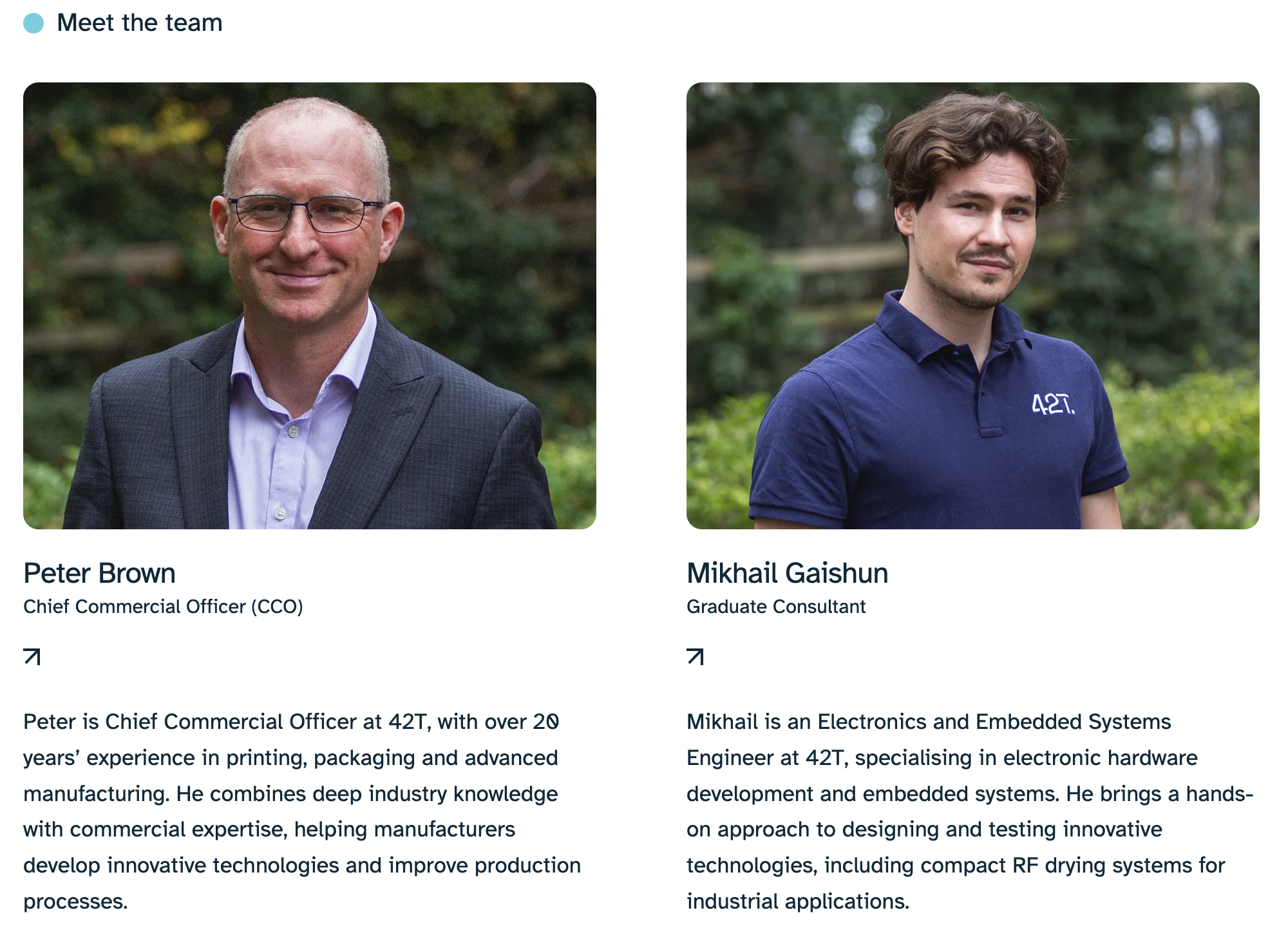
Dr Peter Brown, CCO, 42 Technology explains “RF drying has the potential to transform how the printing industry approaches aqueous inks. By dramatically improving energy efficiency and enabling faster drying across a wider range of inks and substrates, we could help manufacturers reduce operating costs, overcome existing production limitations and unlock new opportunities for more sustainable printing”
Why 42T?
De-risking RF development
Applying RF expertise to demonstrate where the technology could improve manufacturing performance, giving clients greater confidence to invest.
Creating adaptable, licensable IP
Developing proprietary RF technology that clients can build on, reducing the need to start from scratch.
Anticipating the shift to aqueous inks
Combining printing industry knowledge with RF expertise to develop a more efficient drying approach suited to emerging manufacturing needs.