
adphos: Drying and Curing with Light Instead of Hot Air
The German thermal processing specialist fires near-infrared light directly into coatings and liquids rather than heating the air around them, and says the approach cuts scrap, energy use and equipment footprint across printing, coating, metal and battery production.
adphos has been building industrial thermal process systems since 1994. The group today runs to around 70 people, roughly 15 million euros in turnover, and three operating divisions, adphos Thermal Processing, adphos Digital Printing and adphos Innovative Technologies, alongside its own entities in North America and the UK and a wider international partner network. It reports more than 5,000 installed systems worldwide and holds over 200 patents or patent applications on its core technology. adphos is showing a new way to dry.
The problem with hot air
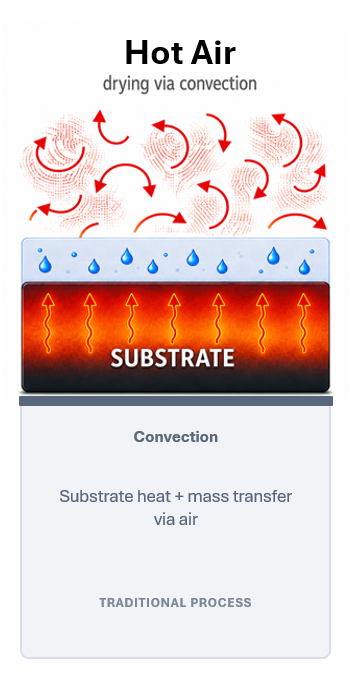
Conventional dryers and ovens lose more than energy. A lot of the cost shows up as time and material. An oven has to heat a large volume of air before the process reaches a stable operating point, and it responds slowly when line speed or the product itself changes. Material keeps running through the process before it has settled, which shows up as scrap during start-up and changeover, manual readjustment, and long, bulky equipment sections built to move and heat all that air.
Putting the energy where it's needed
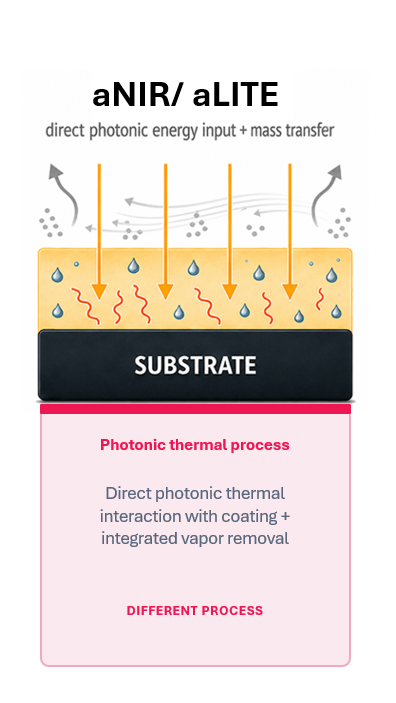
adphos's answer is to skip air as the middle step. In a conventional oven, a heater warms the air or in case of IR or heated plate, they warm the surface, the surface warms the liquid on it, and the liquid evaporates. The air is doing two jobs at once, carrying energy in and carrying moisture out.
adphos's two core platforms, aNIR (advanced Near Infra Red) and aLITE (advanced Light Initiated Thermal Emission), use focused near-infrared light to heat the liquid film directly, so the coating or ink absorbs the energy itself rather than waiting for the surrounding heat of the substrate to warm up completely. A separate, coordinated airflow then removes the resulting vapour. Because there is no large mass to heat and cool, adphos says its systems respond in under 100 milliseconds, closely enough to track changes in line speed almost instantly.
The company reports several knock-on effects: less scrap during start-up and changeover, shorter drying sections and smaller equipment footprints, lower energy use since the substrate and machine structure are barely heated, and lower capital and running costs as a result. Because the process is fully electric, and it can run with no direct CO₂ emissions when powered by renewable electricity, and puts the CO₂ savings across its installed base at more than a million tonnes a year.
Three platforms, one underlying idea
aNIR is the core, higher-power platform, aimed at established applications needing short response times. aLITE extends it with variable air and temperature control for more sensitive or demanding processes. BearLITE applies the same logic specifically to battery electrode drying, and adphos says a commercial pilot line built around it has been running since 2024.
Where this connects to print
For the printing side of adphos's business, applications include drying and curing for inkjet, screen, flexo and gravure, along with printed electronics and direct-to-shape work. The company points to several specific named projects as evidence: an aNIR upgrade to an HP PageWide T2X0 line that it says lifted speed from 55 to 150m/min , and what it describes as the first water-based gravure press for plastic film built entirely around aLITE, and the first high-speed colour inkjet press on plastic film to use the platform.
Beyond print, the same technology is applied to coil coating, metal and surface treatment, PET and plastics thermoforming, and lab and pilot systems for feasibility work. adphos lists working relationships across printhead and press manufacturers, including Epson, Fujifilm Dimatix, HP, Kodak, Xaar, Konica Minolta and Koenig & Bauer, ink and coating suppliers such as Siegwerk and Sun Chemical, and large converters including QuadGraphics and TC Transcontinental Printing.
One current example of that integration work: adphos is developing a drying module with Buskro, designed to sit directly on the print node of Buskro's modular Argo-Verse platform rather than being added on afterwards.
adphos has also joined FuturePrint as an event partner for the Packaging, Labels & DTS Summit in Valencia this September, where the team will be on-site across both days. We covered that partnership in more detail here; this piece is more about the technology itself, and what it's designed to solve.
Find out more about adphos's technology at adphos.com.
