
AI for Industrial Print: Practical Lessons from FuturePrint Munich
The AI for Industrial Print Conference, held at FuturePrint Industrial Print in Munich, brought together manufacturers, OEMs and technology providers to look beyond the noise surrounding artificial intelligence and focus on what is actually working today in industrial print and advanced manufacturing.
From the outset, the tone was pragmatic. Opening the conference, Ed Chesterman of Futureprint reminded the audience that scepticism around new technology is nothing new, and that many of today’s accepted innovations were once dismissed outright. He also highlighted a key challenge facing AI adoption across Europe: while a growing number of enterprises are piloting AI, the main barrier remains a lack of relevant skills and experience. The aim of the day, he suggested, was not to convince anyone to “buy into” AI, but to help close that understanding gap through real examples and honest discussion.

Futureprint asking the important questions about AI in industrial print
That focus on reality carried through the programme. Rather than treating AI as a single solution, speakers explored it as a set of tools that can support decision-making in complex, high-cost production environments. In industrial print — where materials, chemistry, colour, mechanics and software all interact — even small improvements in predictability and consistency can have a meaningful impact.
Several sessions addressed how AI is already being used to make production more transparent and manageable. Dr Peter Brown of 42 Technology shared insights into how data-driven modelling and analysis can be applied to industrial processes, helping manufacturers understand variability, identify root causes of defects, and improve overall system performance. Their contribution underlined how AI can be most effective when it is closely tied to deep domain knowledge.
A similar emphasis on integration came from Simon Edwards of Global Inkjet Systems (GIS), who discussed the growing role of intelligent electronics and data within inkjet platforms. Rather than positioning AI as an external layer, their perspective showed how embedding intelligence directly into print systems can enable better diagnostics, faster feedback, and more responsive control — all of which are essential for scaling industrial inkjet reliably.
The theme of informed decision-making was echoed by Mark Boyt of Keypoint Intelligence, whose analysis-focused perspective helped ground the conversation in market realities. By connecting AI capabilities with commercial outcomes, their input reinforced the idea that successful adoption depends not just on technical feasibility, but on aligning technology with business needs and operational constraints.
Juan Águila Martínez of HP spoke about how AI is being woven into HP’s industrial print platforms in practical ways. Rather than presenting it as something separate or futuristic, he focused on how connected press data can give operators clearer visibility of what’s happening in real time and where attention is needed. The emphasis was on supporting day-to-day production — helping teams spot issues earlier, understand performance trends, and make more informed decisions without adding complexity to the workflow.
Rob Karsten of Excelitas took the discussion a step deeper into the physical side of the ecosystem. He explored how sensing, curing and precision components influence the stability and performance of industrial print systems, and why intelligent software is only as effective as the hardware it relies on. His session was a useful reminder that AI doesn’t operate in isolation; it depends on accurate signals and well-engineered systems to deliver meaningful results.
The programme also made space for broader perspectives beyond engineering alone. Futureprint welcomed new voices from across Europe, such as Franziska Hagenauer of FVH Lab, who, in her talk “Why a Butterfly Closes More Deals Than Your Sales Team,” explored the ecological boundaries between nature’s ability to make sense of complex systems and the business world. She illustrated how insights drawn from natural processes can inform the way AI helps organisations recognise patterns, adapt to change, and make better decisions. Her session offered a refreshing reminder that intelligence — artificial or otherwise — benefits from context, observation and balance.
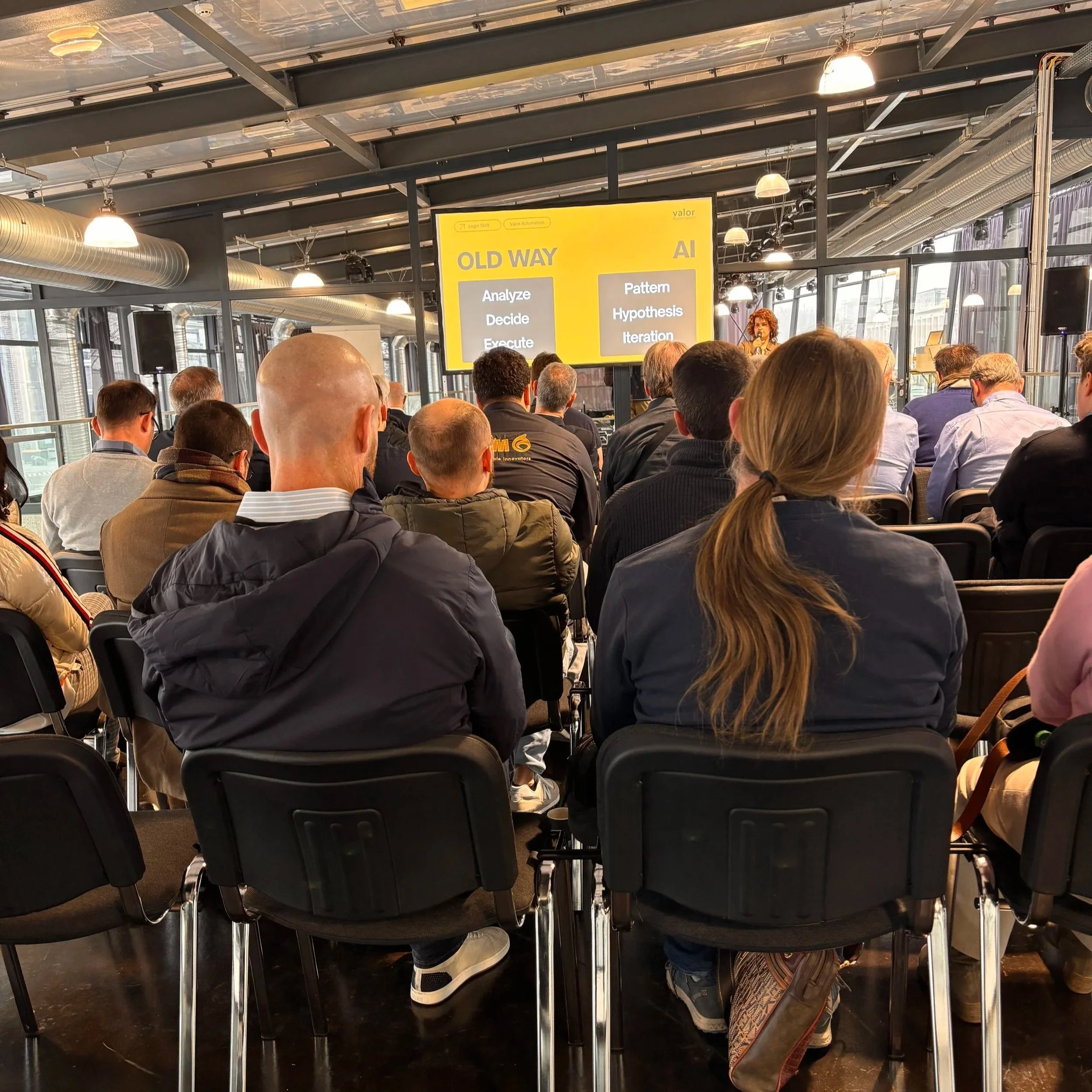
Larissa Witzl of Valor Automation
Complementing this, Larissa Witzl of Valor Automation shifted the focus toward operational structure and leadership, exploring how smart workflows can replace complexity and friction in growing organisations. Her perspective centred on building automations that connect tools, eliminate repetitive tasks, and create predictable, scalable processes. In the context of AI, her message was clear: intelligent systems are most powerful when they quietly support the business in the background — keeping operations running smoothly, even when leadership isn’t directly hands-on.
Across the day, speakers were open about the challenges involved in implementing AI — from data quality and integration issues to organisational readiness and skills development. A recurring message was that AI delivers the most value when it quietly supports human expertise: monitoring systems continuously, flagging anomalies, and surfacing insights that would otherwise be missed, while leaving final judgement with experienced operators and engineers.
“When the winds of change blow, some people build walls and others build windmills”
The audience reflected this maturity of discussion. Alongside organisations already deploying AI, there were many attendees looking to understand where experimentation makes sense and where caution is still warranted. Informal conversations between sessions were as valuable as the presentations themselves, with delegates comparing experiences and learning from each other’s successes and setbacks.
By the end of the conference, the takeaway was clear: AI in industrial print is no longer a future concept, but neither is it a shortcut. Its value lies in thoughtful application, realistic expectations, and close collaboration between technology providers and manufacturers. The conversations in Munich suggested an industry increasingly focused on building practical “windmills” — systems that harness change in a controlled, productive way — rather than resisting it altogether.
