
Beyond the Flatbed: How Robojet is Expanding the Possibilities of Direct-to-Shape Printing
For years, direct-to-shape printing has promised manufacturers a more flexible way to decorate products. The ability to print directly onto an object rather than applying labels, transfers or secondary processes offers obvious advantages. Yet one challenge has remained constant: objects are rarely flat.
From sports equipment and drinkware to automotive components and consumer products, real-world products come with curves, handles, contours and irregular surfaces that can make traditional printing difficult.
This is where robotics is beginning to change the conversation.
Developed by Cyan Tec, Robojet combines industrial robotics, inkjet printing, curing and pre-treatment technologies into a modular platform designed specifically for direct-to-shape applications. Rather than forcing products to fit around the limitations of a printer, Robojet allows the print process to adapt to the product itself.
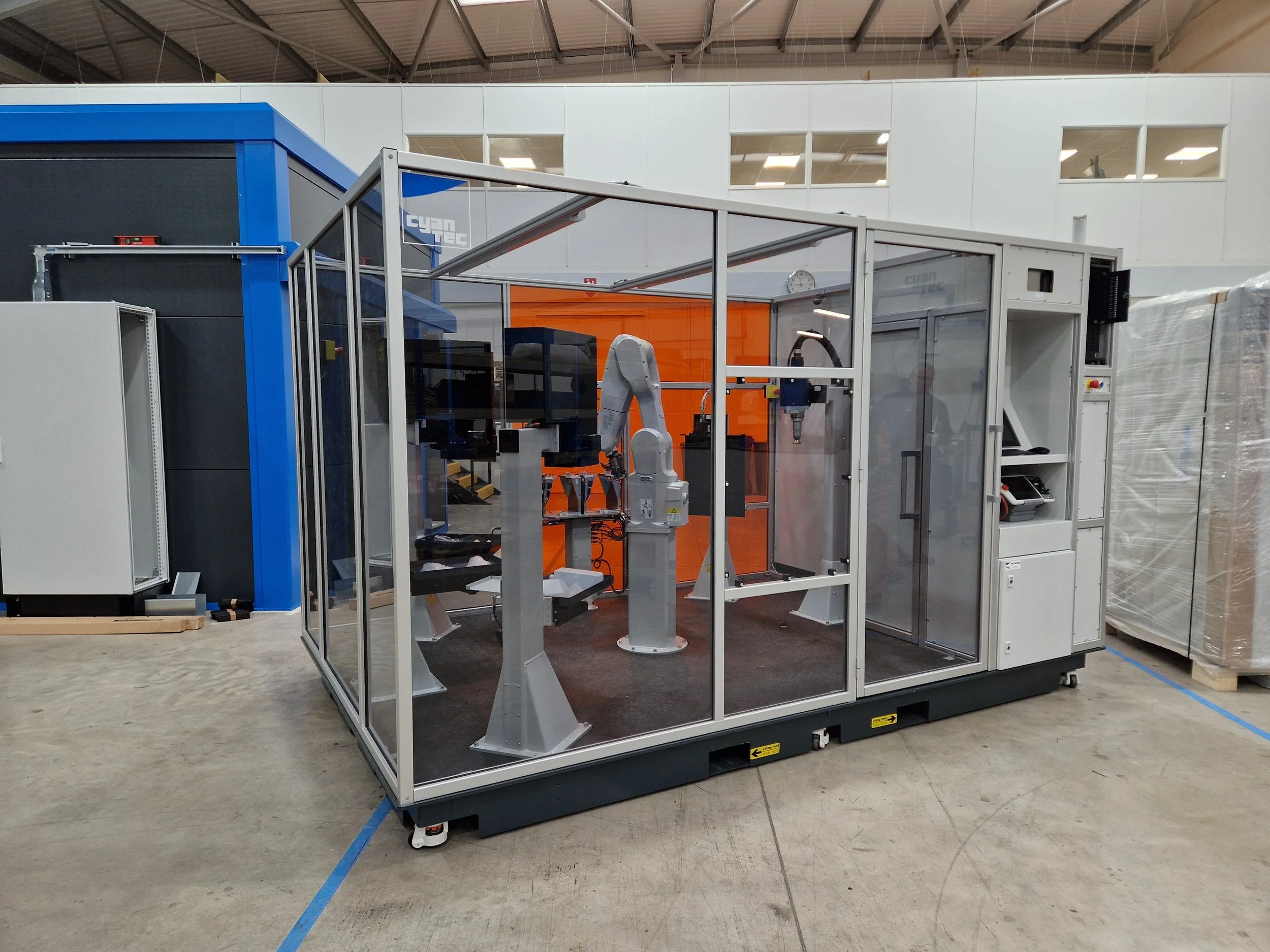
A Modular Approach
At the heart of the system is a programmable architecture built around a PLC (Programmable Logic Controller), which acts as the brain of the platform.
The PLC controls the workflow, coordinating everything from barcode scanning and product recognition through to robotic movement, pre-treatment, print execution and final curing.
If a product enters the system and a barcode is scanned, the PLC determines what the item is and instructs the robot on the exact process required. The robot arm becomes the physical extension of those instructions, positioning products and printheads with precision throughout the production cycle.
Alongside this sits a customised HMI (Human Machine Interface), designed specifically around the customer's application. Where the PLC is the brain, the HMI serves as the eyes of the system, giving operators visibility and control over production.
This modular architecture allows Cyan Tec to configure each installation according to customer requirements, whether that means adjusting pre-treatment methodology, print resolution, colour configuration, curing stages or material handling systems.
More Than Just Printing
One of Robojet's key strengths is that it extends beyond simply placing ink onto an object.
Many substrates require preparation before printing can take place. Depending on the material, this may involve plasma treatment or corona treatment to improve surface energy and ensure the ink bonds correctly.
Cyan Tec's development team works with customers to identify exactly what level of treatment is required, using in-house testing facilities to optimise adhesion and print quality before a system is deployed.
The same philosophy applies to curing. Customers can incorporate pinning lamps to partially cure inks during the print process, followed by final UV curing stages once printing is complete.
Where required, conveyors, handling systems, pre-treatment units and curing stations can all be integrated into the wider industrial inkjet platform, creating a complete production solution rather than a standalone printer.
What Can Robojet Print On?
The flexibility of the robotic approach opens the door to applications that would be challenging or impossible for conventional flatbed systems.
Recent demonstrations have included footballs and American footballs, products that present obvious difficulties due to their curved surfaces and complex geometry.
The system has also been used to print mugs with handles, another application that can be problematic for traditional direct-to-object printing equipment.
Sports footwear represents another emerging opportunity. Cyan Tec has demonstrated printing directly onto running shoes, where robotic positioning allows graphics to be applied accurately across irregular surfaces.
Even products such as guitar bodies can be accommodated, illustrating the growing range of applications where robotics and inkjet can work together.
What Does Robojet Offer That a Flatbed Cannot?
Flatbed printers remain highly effective for many applications, particularly where products are relatively uniform and flat.
However, once shapes become more complex, limitations begin to emerge.
A robotic system can dynamically adjust the position, angle and movement of the printhead relative to the object being decorated. This makes it possible to maintain consistent print quality across curved or irregular surfaces without requiring complex fixturing or multiple production stages.
More importantly, robotics enables a level of flexibility that aligns with one of the biggest trends in manufacturing today: mass customisation.
Whether it is personalised sports equipment, customised promotional products or short-run consumer goods, manufacturers are increasingly looking for ways to produce unique products efficiently. Robotics provides a route to achieve this without sacrificing productivity.
A Platform Built Around the Customer
Perhaps the most important aspect of Robojet is that it is not a fixed machine with a fixed specification.
The platform is designed to be configured around the application. Some customers may require advanced pre-treatment systems and multiple curing stages. Others may need a simpler setup focused purely on direct-to-shape decoration.
By building around customer requirements rather than forcing customers into a predefined configuration, Cyan Tec has created a system that reflects a broader trend across industrial printing.
As robotics, automation and inkjet technologies continue to converge, the future of direct-to-shape printing is becoming less about the printer itself and more about creating complete, flexible manufacturing solutions.
Robojet is a clear example of how that future is beginning to take shape.
