
CAMCODE10: Rethinking Motion Control for the Next Generation of Industrial Inkjet
When print quality problems occur in industrial inkjet, the first instinct is often to look at the printheads, the ink, or the waveform. But according to KELENN Technology, one of the biggest factors affecting print quality lies elsewhere entirely: motion.
As print speeds increase and applications become more demanding, even small variations in substrate movement can lead to visible defects. Misalignment, stitching errors, colour shifts, blurred images and inconsistent registration are often symptoms of a problem that traditional encoder systems struggle to detect.
To address this challenge, KELENN Technology has developed CAMCODE®, a camera-based, non-contact motion control system designed specifically for high-precision industrial printing environments.
Moving Beyond Mechanical Encoders
For decades, industrial printing systems have relied on wheel encoders to measure substrate movement. While effective in many applications, mechanical encoders have inherent limitations. Conveyor belt stretching, substrate slip, vibration, lateral movement and mechanical tolerances can all introduce errors between what the encoder measures and what is actually happening at the print zone.
The result is dot placement error.
As print resolutions increase and industrial inkjet moves into more demanding applications such as direct-to-shape, packaging, electronics and decorative surfaces, those errors become increasingly difficult to tolerate.
CAMCODE takes a fundamentally different approach.
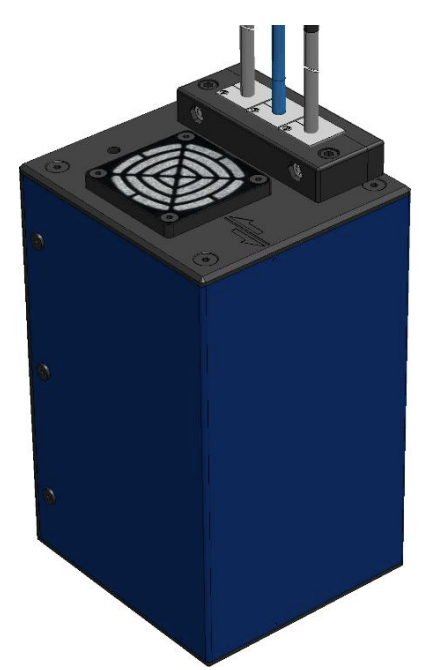
The Camcode10
Rather than measuring movement mechanically, the system uses a high-speed camera and advanced image processing to analyse the natural microstructure of the substrate itself. By tracking the actual surface being printed, CAMCODE measures movement exactly where printing occurs.
The system works without encoder wheels, ruler tapes, optical scales or registration marks, providing real-time motion data directly from the substrate surface.
Precision Through Vision
At the heart of CAMCODE is a combination of high-speed imaging, embedded FPGA processing and AI-driven algorithms.
The technology analyses natural surface features in real time and converts movement data into standard encoder signals that can be used directly by industrial print systems.
According to KELENN, CAMCODE can achieve relative displacement accuracy below one micron while maintaining reliable operation at speeds of up to 6 metres per second. The system can generate stable encoder outputs up to 1200 dpi and can be configured for higher resolutions where required.
Importantly, it works across a wide range of materials including paper, corrugated board, plastics and even conveyor belts themselves.
Solving Real Production Problems
The value of the technology becomes particularly apparent in challenging production environments.
Traditional wheel encoders can struggle when substrates slip relative to transport systems. In one demonstration, a printing system operating at 200 metres per minute experienced alignment problems because the mechanical encoder could not accurately compensate for movement variations. CAMCODE provided direct motion measurement and real-time correction, restoring printhead alignment and improving print quality.
The technology is also capable of acting as a diagnostic tool for machine builders and operators.
By continuously analysing motion behaviour, CAMCODE can identify speed variations, resonance frequencies and mechanical issues that would otherwise remain hidden. KELENN describes the system as functioning like a "stethoscope" for industrial machinery, allowing engineers to detect problems such as faulty pulleys, vibration issues or transport instability before they affect production.
Built for Industrial Integration
Beyond performance, CAMCODE has been designed with practical implementation in mind.
The system communicates via Ethernet, offers programmable resolutions, and includes software tools that allow users to analyse motion behaviour and download measurement logs. Installation is simplified because there is no need for physical scales, tapes or contact-based measurement systems.
An automatic optical glass cleaning function further supports long-term operation in demanding industrial environments.
A New Approach to Print Quality
As industrial inkjet continues its expansion into packaging, direct-to-shape decoration, printed electronics and advanced manufacturing applications, the industry's focus is increasingly shifting from individual print components to complete system performance.
KELENN's view is straightforward: print quality is not simply determined by ink and printheads. It is fundamentally linked to motion control.
By measuring substrate movement directly and eliminating many of the uncertainties associated with mechanical encoders, CAMCODE represents a different way of thinking about print accuracy—one that could become increasingly important as production speeds rise and quality expectations continue to increase.
For machine manufacturers and print providers looking to improve registration, reduce defects and gain deeper visibility into machine performance, CAMCODE offers an intriguing glimpse of what the next generation of motion control could look like.
