
Film Review - Clean Slate: Rethinking Events
This article is inspired by a recent podcast. You can listen by clicking here, or on the graphic below.
The global events industry sells experience and emotion.
A trade show booth that rises overnight. A brand world built in three days. A live concert tour that inspires, then heads off to the next city. After any event, everyone goes home. The venue returns to normal.
Job done.
But is it?
That tension - between temporary experience and permanent footprint - sits at the heart of Clean Slate: Rethinking Events, a documentary created by Nova Abbott, Claire Goodchild and Sarah Goodchild, and discussed with Marcus Timson on the FuturePrint Podcast. The film does not preach. It does not shame. Instead, it does something more effective: it pauses a professional audience long enough to question whether what has become “normal” is actually good enough.
A recurring theme is not judgement, but momentum. Events move fast. They have to. When one project ends, the next begins. The easiest decision is to repeat what worked last time. It was delivered on time, the client was happy, and no one complained. But for the environment, could it have been done better, without costing more?

Click on the graphic to listen to the podcast interview.
Not experts - insiders
The filmmakers are careful about labels. They are not sustainability specialists. They are insiders. Experienced event professionals who have reached the point where what they know no longer aligns with doing nothing.
Claire spent close to 18 years working across exhibitions, conferences, brand launches, retreats and executive gatherings. Sarah followed a similar path, delivering consumer entertainment and conferences under intense time pressure, always balancing quality with the unspoken requirement of being hired again. That incentive matters. In many agencies and client teams, the person who asks inconvenient questions risks being labelled “difficult”.
Nova’s route is slightly different. Starting in large B2B tradeshows, she later moved into wide-format material manufacturing and lifecycle assessment, before reaching a blunt conclusion: recycling is not enough. The hierarchy matters - reduce, reuse, recycle, in that order. Yet much of the industry’s sustainability comfort blanket sits firmly at the bottom of that list. If something is recyclable, the conscience is soothed, even when systems fail to recycle it in practice.
This is where the film’s strength lies. It pulls sustainability out of abstraction and anchors it in the operational reality of an industry built on temporary structures with long-term consequences.
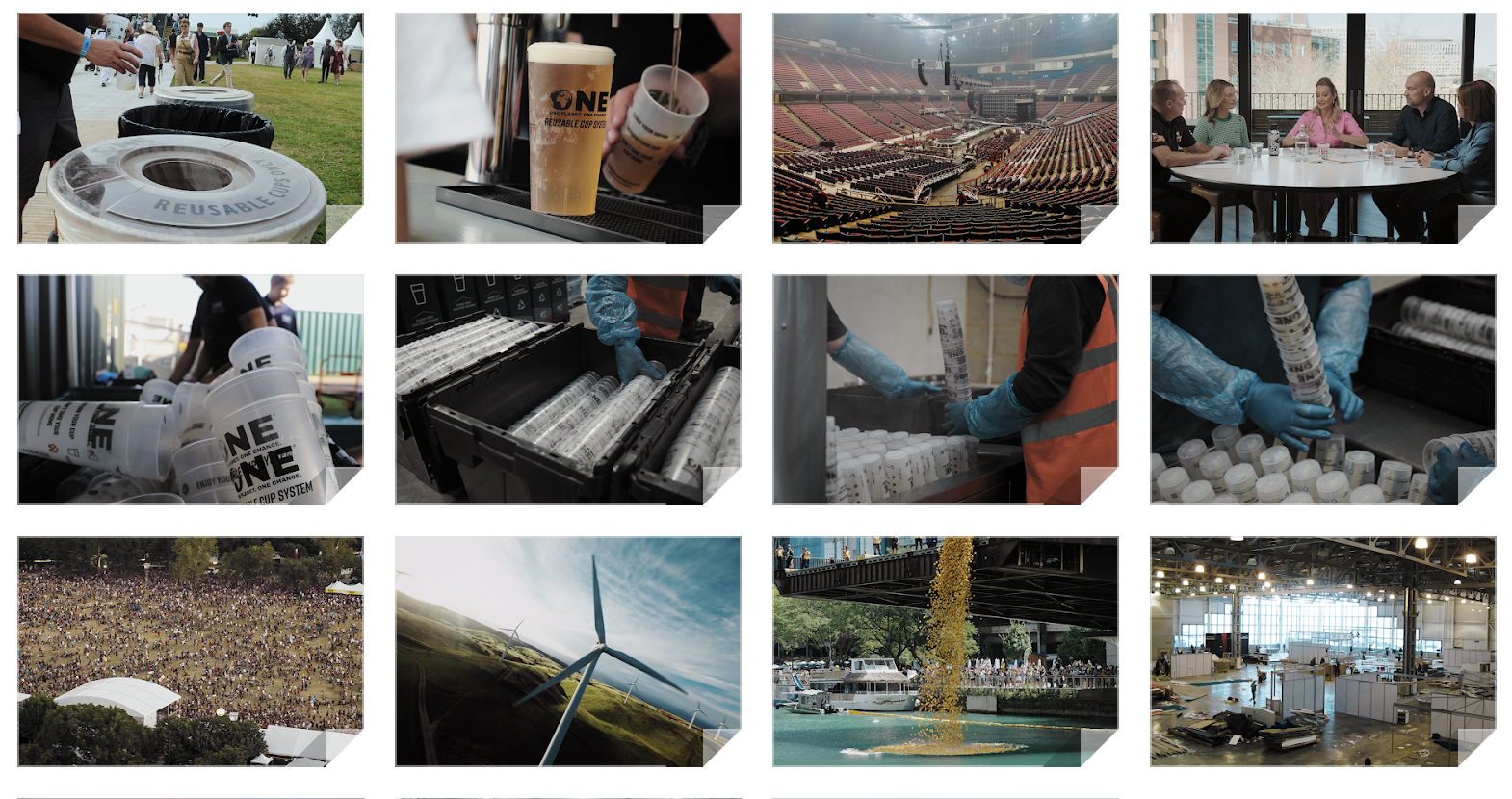
Events are an integral part of any community, rethinking them at the point of design minimises damage
The temporary illusion
Events are designed to be experienced once. Their infrastructure is built quickly and removed even faster. That is part of the magic. It is also an environmental problem.
As Sarah puts it succinctly: the event itself is temporary, but what happens afterwards is long-living. Waste does not dissolve when the audience leaves. It simply changes its postcode.
Nova and her colleagues did something that seems obvious, yet is rarely (or never) done. They tracked printed graphic materials after events. Not just banner substrates, but the broader mix of materials left behind at breakdown: carpets, graphics, packaging, and the inevitable debris of time-compressed builds.
They followed this waste after events in both Germany and the United States. Different continents, similar outcomes. In the US, much went to landfill. In Germany, more went to waste-to-energy incineration. A more palatable endpoint, perhaps, but still not circular. In both cases, “recyclable” did not mean recycled.
The film’s central provocation is clear: the industry has mistaken disposal theatre for a disposal strategy. Without a sustainability plan, avoidable environmental damage is built into the system.
The banner problem - and the systems problem
One statistic lands with the weight it deserves. Around 35 percent of event waste, Nova notes, is banner-related material: signage and graphics. The exact figure may vary by event type, but the structural issue is clear. Events are communications machines. They print their message everywhere, and then discard it.
Graphics are a perfect example of sustainability as an afterthought. They are often finalised late, produced fast, and treated as consumables. The film argues for a shift upstream. Sustainability is not a line item at the end of a Gantt chart. It is a design constraint at the beginning.
The same logic applies to waste management. Claire references insights from Chris Hessey from iKlean, a waste-management professional featured in the film. Waste is often the last budget line, yet one of the few that can be significantly shaped through planning. Bring waste experts in early, and systems can be designed to prevent contamination, improve separation, and even make it easier for audiences to do the right thing. A giant pizza-box posting station is one small but fun example.
The detail matters because it reveals the real lever. Behaviour is not solved by virtue. It is solved by design.
The myth that sustainable costs more
The creators are realistic about industry scepticism. The default objection is financial: sustainability must mean higher costs. Their response is not moralistic. It is managerial.
Sustainability costs more when it is bolted on late, like any last-minute change request. When integrated into the design from the outset, it is far more likely to be cost-neutral. The biggest investment is often time: additional research, broader supplier conversations, and a willingness to challenge default decisions.
That points to the industry’s real constraint: speed. Events culture rewards rapid delivery, visible spectacle, and risk-free repetition. But speed also generates waste. The film’s thesis is simple. Slow down at the beginning to avoid scrambling, and dumping, at the end.
For Sarah, the documentary offers something practical and personal: confidence. Not opinion-based confidence, but evidence-based confidence. With facts in hand, she can enter client conversations and be clear. Creativity is non-negotiable, and sustainability cannot be an afterthought.
A gentler form of activism
The tone of Clean Slate is deliberately measured. There is no finger-pointing. Instead, it treats the events industry as a system: a network of incentives, habits, contracts and time pressures that quietly produce waste as a by-product.
That system-level framing is why the film may travel further than much sustainability content. It meets professionals where they are, inside real-world constraints. It reframes sustainability not as moral heroics, but as better planning.
The creators also emphasise the next generation. If junior producers and designers enter the industry with reduce, reuse, recycle embedded as standard thinking, the impact compounds. Change happens through hundreds of small choices: modular rentals, reusable materials, better material selection, earlier waste planning, fewer assumptions about recyclability, and tracking where materials actually end up.
What success looks like
The ambitions behind Clean Slate are refreshingly uncorporate. It was not conceived as a start-up or product play. The initial goal was awareness. More attention. Better questions.
That may sound modest. It is not. In habit-driven industries, attention is the scarcest resource. Once attention shifts, procurement follows, and supply chains adapt. The documentary acts as a storytelling lever, prising open the gap between what the industry says and what it does.
The closing message is an invitation, not an accusation.
Because the party will always end. The question is whether the environment has to carry the burden.
Maybe now could be the time for a clean slate. And time to rethink how we design and deliver events.