
From Fluid to Functional Material: Balancing Chemistry, Optics, and Process in UV Curing
When people talk about inkjet moving into industrial manufacturing, the conversation often focuses on printheads, drop formation, or fluid development. Those are all important pieces of the puzzle, but one piece that is often underestimated is the curing. Once a functional fluid has been precisely deposited, it still needs to be transformed into a stable and performing layer.
This topic was on my mind recently while attending LOPEC, walking the exhibition floor and speaking with different companies working in printed electronics. Inkjet is continuing to establish itself as a manufacturing technology in this space. Over the past decade, what started as exploratory research has steadily moved into production applications, from PCB legend printing to solder mask deposition and beyond. . While screen printing still plays a dominant role in many of these processes, the advantages of inkjet—such as precise material placement and digital flexibility—are making it increasingly attractive as a complementary manufacturing method.
As Inkjet is more widely adopted in functional printing, companies are developing new printers, fluid systems, and development tools to help researchers and manufacturers experiment more easily and accelerate the transition from laboratory development to production.
However, printing the material is only one part of the challenge. As inkjet moves into functional inks and fluids—materials designed to conduct electricity, create structures, or deliver optical performance—the curing step becomes a crucial part of the overall process ecosystem.

Traditional inkjet applications in graphics printing focus on colour, adhesion, and surface durability. Functional fluids, on the other hand, are designed to deliver performance. These fluids may contain conductive metals, nanoparticles, ceramic fillers, or complex polymer systems.
This change in material composition brings a completely different set of curing requirements. The printed layer must not only adhere to the substrate but also maintain specific electrical, mechanical, or structural properties.
Functional fluids behave very differently from conventional UV inks. Many contain high levels of pigments, nanoparticles, or conductive materials that can significantly influence the curing process.
One challenge is limited light penetration. Highly loaded inks—especially those containing carbon black or white (TiO₂)—can absorb or scatter UV energy, making it difficult for light to penetrate the printed layer and shortening cure depth. This can result in incomplete curing or inconsistent material properties.
Another factor is oxygen inhibition, which can interfere with the polymerisation process in free-radical UV systems. Oxygen can prevent the film surface from fully curing, leading to application issues with thin printed layers.
Environmental conditions can also affect the process. Humidity, for example, can influence certain curing chemistries. Substrates such as PET or polypropylene need to be carefully managed to avoid excessive heat during curing; here, LED curing can be advantageous due to its lower IR output.
Functional inks with high pigment loading can have dispersion challenges and increased viscosity. These factors can impact adhesion, mechanical stability, and overall print performance if not carefully managed.

Practical applications from LOPEC
Thinking from a practical perspective, successful curing of functional fluids requires balancing three main elements: chemistry, optics, and process control.
The formulation—including resin systems, photoinitiators, and additives—needs to be designed to work with the curing technology being used. The wavelength and intensity of the curing system must match the photoinitiator package's absorption characteristics. Finally, parameters such as exposure time, conveyor speed, temperature, and environmental conditions must all be controlled to achieve consistent results.
One question that often comes up is what parameters should actually be measured. In many cases, curing problems arise not because of a technical issue, but because the process conditions are not fully understood or monitored.
Key parameters include Peak irradiance (intensity), total UV Irradiance (dose) reaching the substrate, spectral match between the UV source and photoinitiator system, film thickness and pigment loading, and environmental conditions such as oxygen and humidity.
Verification tests are also important. Techniques such as solvent rub tests, adhesion cross-hatch testing, and spectroscopic methods (e.g., FTIR) can help confirm whether the material has achieved the required level of polymer conversion and performance.
In many functional printing applications, curing is not a single step but part of a broader manufacturing sequence. Conductive silver inks used in flexible electronics, for example, are often UV pre-cured to stabilise the printed pattern before undergoing thermal or photonic sintering to achieve the desired electrical conductivity.
This application demonstrates how curing technologies are becoming integrated with other processing steps within the manufacturing workflow.
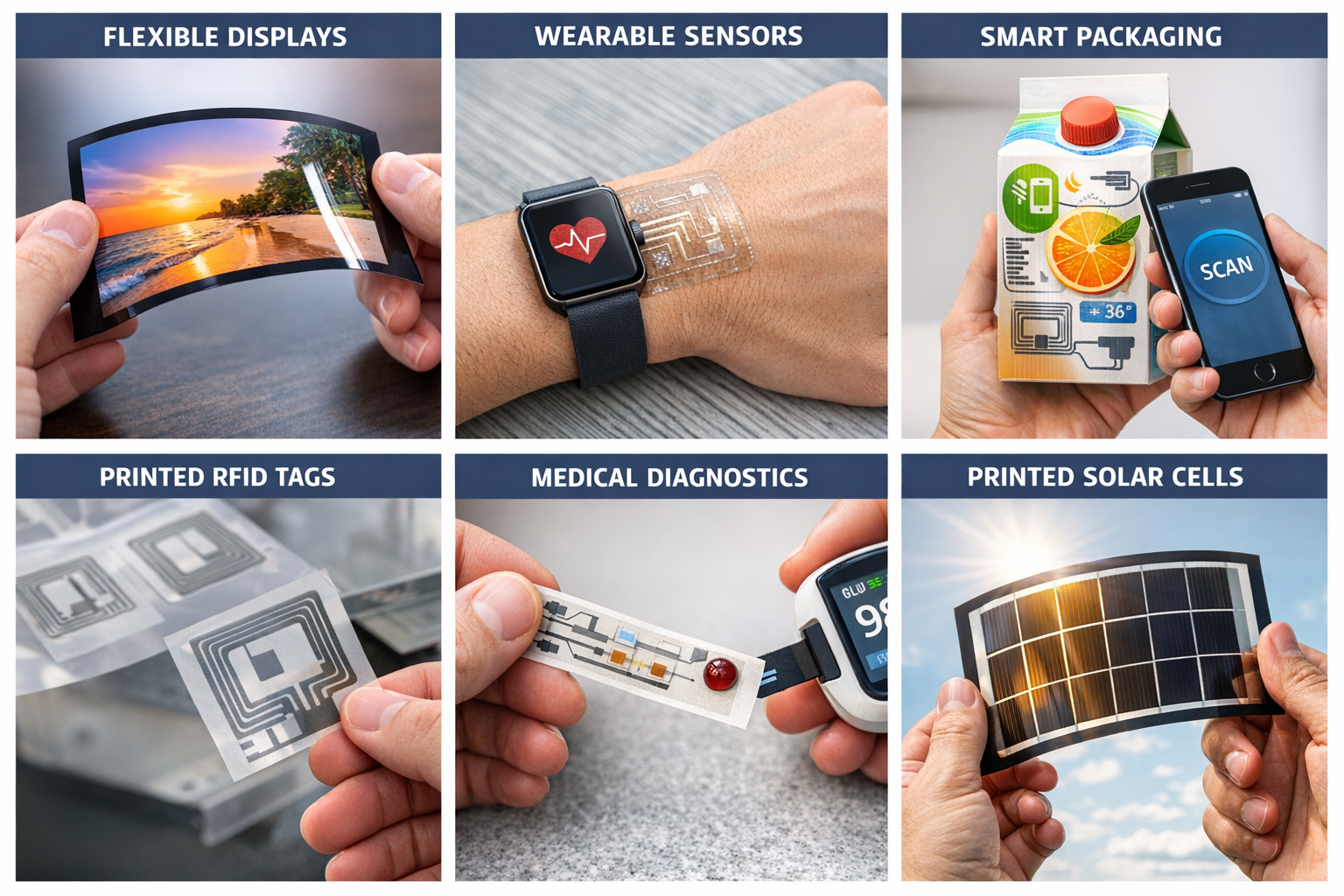
Inkjet has already proven its value in graphics and packaging. As it moves further into functional materials and printed electronics, curing will be one of the key technologies that help turn precise droplet placement into reliable industrial performance.
As functional inks continue to evolve, curing systems must adapt to handle new materials, higher filler content, and increasingly demanding application requirements.
We are moving in the right direction in the energy curing space, and technologies are evolving quickly to support the growth of functional inkjet applications. Higher-dose UV-LED systems, LED-optimised photoinitiators, and hybrid curing workflows are enabling the processing of increasingly complex functional materials.
curing will be one of the key technologies that help turn precise droplet placement into reliable industrial performance.
As inkjet moves further into printed electronics, sensors, and advanced materials, curing technologies will continue to play a central role. Inkjet may place droplets with incredible precision—but it is curing that ultimately determines whether those droplets become reliable, functional devices.
Developing reliable production processes requires the right combination of materials knowledge, curing technology, and measurement capability.
One place supporting this type of development is my company's IST Technology Campus in Germany. The campus provides laboratory and application facilities where customers can evaluate UV and LED curing processes, test materials, and investigate curing parameters.

IST Tech Campus in Germany
To delve deeper into UV dose, intensity, and measurement techniques, check out the IST Intech white paper library, which provides detailed guidance on measurement methods and curing optimisation.
If you are interested in how inkjet is progressing within the printed electronics ecosystem, you can read my article from LOPEC 2025 here: LOPEC 2025 show review article, where I share observations from last year's event and how the industry is working to enable wider adoption of inkjet technologies in functional applications.
