
Gallus backs flexibility, smarter production, and the connected pressroom
In print, success used to be measured in engineering terms. Speed. Stability. Print quality. Uptime. Those still matter, of course. But increasingly they are not enough. The more consequential question now is whether a press platform can adapt - not just to different jobs, but to a different kind of business environment altogether.
That is the argument emerging from a revitalised Gallus.
In conversation with Thomas Schweizer, CSO at Gallus, we learned of a business that has spent the past few years not merely refreshing its product range, but rethinking the architecture around it. The result is a company that looks less like a traditional narrow web press manufacturer and more like a systems provider for a market defined by uncertainty, shorter runs, hybrid workflows and growing software dependency.
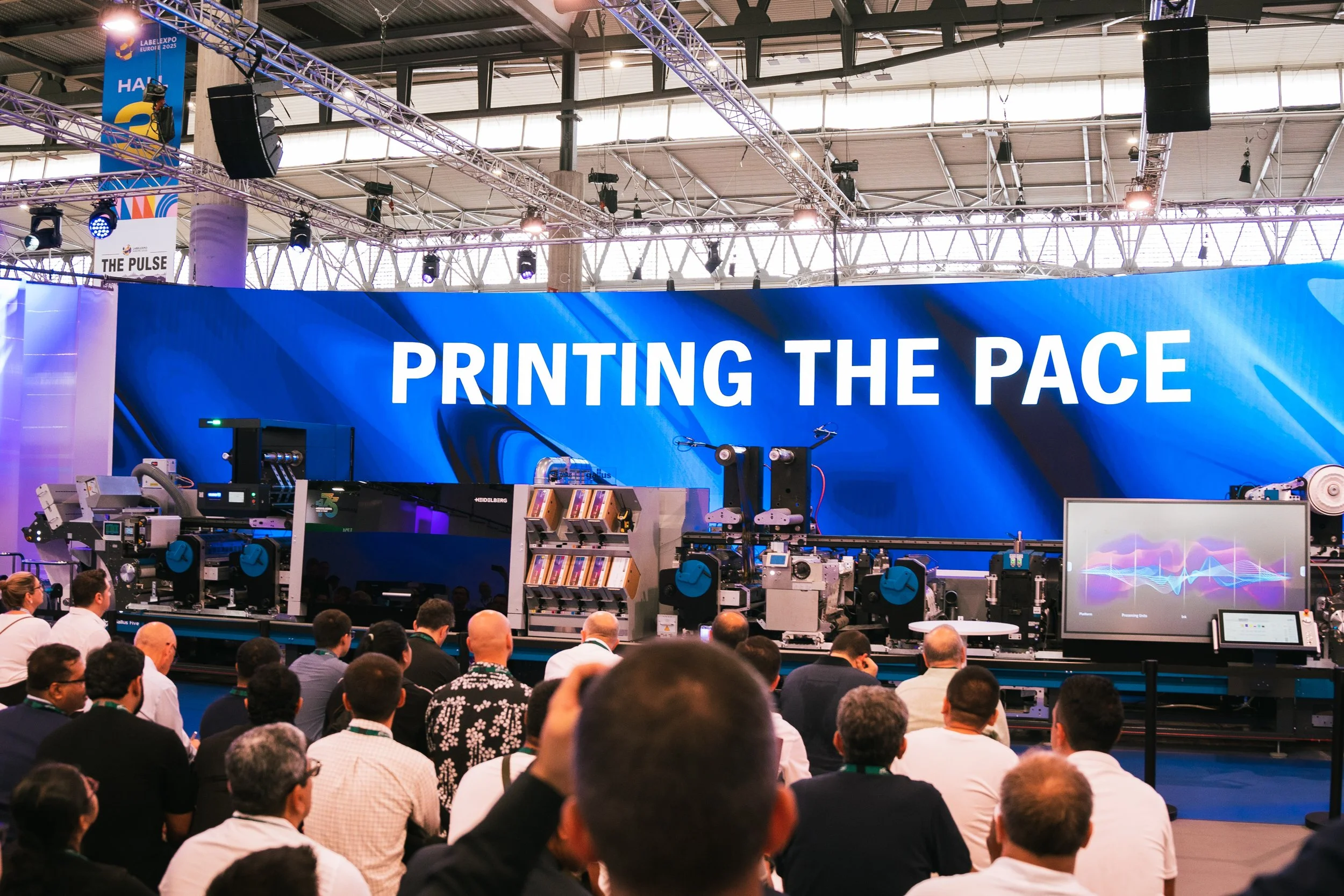
Labelexpo back in September 2025 was, in that sense, more than a trade show. For Gallus, it was a statement.
Labelexpo back in September 2025 was, in that sense, more than a trade show. For Gallus, it was a statement.
Schweizer describes it as a milestone in the company’s wider transformation. The visual presentation mattered - a new booth concept, new colours, a more modern stage for the technology and the people behind it. But the real signal came from the products themselves, led by the Gallus One and the Gallus MatteJet technology for wine and spirits, alongside the introduction of the Gallus Alpha, a more affordable high-resolution digital platform designed to provide an accessible gateway to digital production. At the centre of the stand, however, sat the brand new Gallus Five and its 100-metre-per-minute full-resolution inkjet capability - a marker that Gallus wanted the market to read as proof of industrial performance, reliability, and commercial viability at scale.
That message landed. But the more interesting story may be what sits behind it.

From machine choice to system design
For decades, converters made a relatively straightforward capital decision. Flexo or digital. Inline or offline. A machine was selected, installed, and then expected to earn its keep across a fairly stable operating model.
That logic is breaking down.
Gallus’s answer is what Schweizer calls the "System to Compose" - a modular approach that treats the press not as a fixed destination but as a configurable platform.
From machine choice to system design
For decades, converters made a relatively straightforward capital decision. Flexo or digital. Inline or offline. A machine was selected, installed, and then expected to earn its keep across a fairly stable operating model.
That logic is breaking down.
Gallus’s answer is what Schweizer calls the "System to Compose" - a modular approach that treats the press not as a fixed destination but as a configurable platform. The principle is simple enough. Customers should no longer have to make a binary decision between conventional, digital or hybrid. Instead, they should be able to assemble a system from building blocks that fit their specific needs, then adapt it over time.
The importance of this is not only mechanical. Gallus is applying the same thinking to software, service, workflow and training. A modular machine is of limited use if the surrounding organisation remains rigid. So the platform extends beyond hardware into education, retrofit capability, and application support.
This reflects a broader shift in how capital equipment is being judged. Buyers no longer want a machine that is merely good on the day of installation. They want an investment that preserves optionality.
Why the old flagship is selling again
One of the more revealing points in Schweizer’s account is that Gallus’s current success is not confined to its newest digital technology. The Gallus RCS, its heritage platform available in either flexographic or offset, has enjoyed what he describes as an unexpected revival. Indeed, recent RCS sales have been stronger than at any other point in the product’s history.
That is not what one might have predicted in a market so heavily focused on digital transition. But the explanation is logical.
For jobs above roughly 10,000 linear metres, customers still see a strong case for a robust, highly reliable conventional platform with fast setup, low waste and predictable performance. In other words, as digital strengthens its position in shorter and more variable work, it is also clarifying where analogue continues to make sense.
This is not a contradiction. It is market segmentation becoming more precise.
The Gallus Five may dominate the conversation, especially where throughput, ink efficiency and total cost of ownership are concerned. But the Gallus RCS revival suggests that converters are becoming more sophisticated in matching technology to job profile rather than chasing digitisation for its own sake. A future-ready production floor may not be purely digital. It may be intelligently mixed.
TCO is no longer a side calculation
Schweizer is clear about what customers are prioritising. It is not hype. It is economics.
Converters have increasingly rigorous total cost of ownership models. They are calculating ink consumption, service cost, investment levels, running costs and sweet spots by application. That is pushing the market towards more forensic capital decisions.
This is important because it signals a maturing buyer mindset. Digital adoption in labels and packaging is no longer being driven by novelty or generalised promises of agility. It is being driven by spreadsheets.
That favours suppliers that can demonstrate not only performance, but also a credible path to value across a wider operating system. Gallus appears to understand this. The company’s emphasis on modularity, retrofitability and training is not decorative. It is there because a TCO promise is only as good as the customer’s ability to realise it on the factory floor.
A more connected production environment
If Gallus’s recent story has been about platform renewal, Schweizer suggests the next chapter will be about connectivity.
His view is that the age of smart printing - vision systems, automated quality, baseline machine intelligence - is already established. The next wave is not simply smarter machines, but more connected ones. That means presses designed with APIs, interfaces and open communication in mind, capable of exchanging data with the wider software environment in both directions.
This is where the conversation becomes more strategic.
A print machine, in Gallus’s view, should not merely execute jobs. It should feed information into production management systems, support AI-assisted planning, and interact with external software that determines job sequencing, performance benchmarking and workflow optimisation. It should be part of a digital production environment rather than a standalone asset.
Schweizer gives a practical example: customers increasingly using Power BI to build data lakes that aggregate performance information across different machine vendors. They are no longer content to read isolated reports from individual presses. They want a cross-factory view of performance, waste, uptime and output.
That has two consequences. First, equipment vendors must make connectivity a core design feature rather than an afterthought. Second, converters themselves will need greater software literacy. The print factory of the future will not be run by mechanics alone.
Turning capability into performance
Gallus’s priorities for 2026 reflect this. Schweizer points to software development as a major strategic focus, supported by HEIDELBERG’s broader software and global service capabilities. That support matters. Building stable software at scale, then maintaining and supporting it internationally, is not something every press manufacturer can achieve alone.
But Gallus also seems aware that software capability is meaningless without human adoption. That is where the Gallus Print Academy comes in.
This may be one of the more important parts of the company’s strategy. Schweizer identifies a familiar customer pain point: a converter may have several conventional flexo presses and perhaps an electrophotographic line, but still feel uncertain about how to integrate a hybrid platform operationally. The barrier is not only financial. It is cultural and procedural.
How do operators learn to move jobs from flexo to hybrid? How do workflow specialists prepare files and schedules differently? How does quoting change? How does stock management change when just-in-time production becomes more viable? How does a company avoid using a hybrid machine simply as an expensive flexo press?
These are not small questions. And they help explain why hybrid investments can underperform when customers are left to figure them out alone.
The Print Academy is Gallus’s answer: not just training on button presses, but on the workflow, commercial and operational logic needed to make hybrid profitable in practice. Crucially, the Print Academy extends beyond the classroom, aligning teams, workflows and decision-making where it matters most: in live production.
A new kind of press manufacturer
Taken together, this suggests Gallus is trying to become something more than a machinery supplier. It wants to be an enabler of transition - from conventional to hybrid, from hardware-led thinking to software-led thinking, and from isolated equipment decisions to connected manufacturing strategy.
That is a more demanding role. But it may also be the right one.
Print is entering a phase where technical excellence is assumed. The real differentiator is increasingly how well a supplier helps its customers navigate change - economically, operationally and digitally.
Gallus appears to have recognised that earlier than many. The market response at Labelexpo, and the resurgent strength of both its digital and conventional platforms, suggests customers are noticing too.
Take a look at the impressive Gallus 5 film below :)