
25th November 2026 - FuturePrint was at Industrial Print Integration in Düsseldorf this week. Between the talks and the stands, we came across some interesting projects where inkjet is being put to work, and one where it isn't.
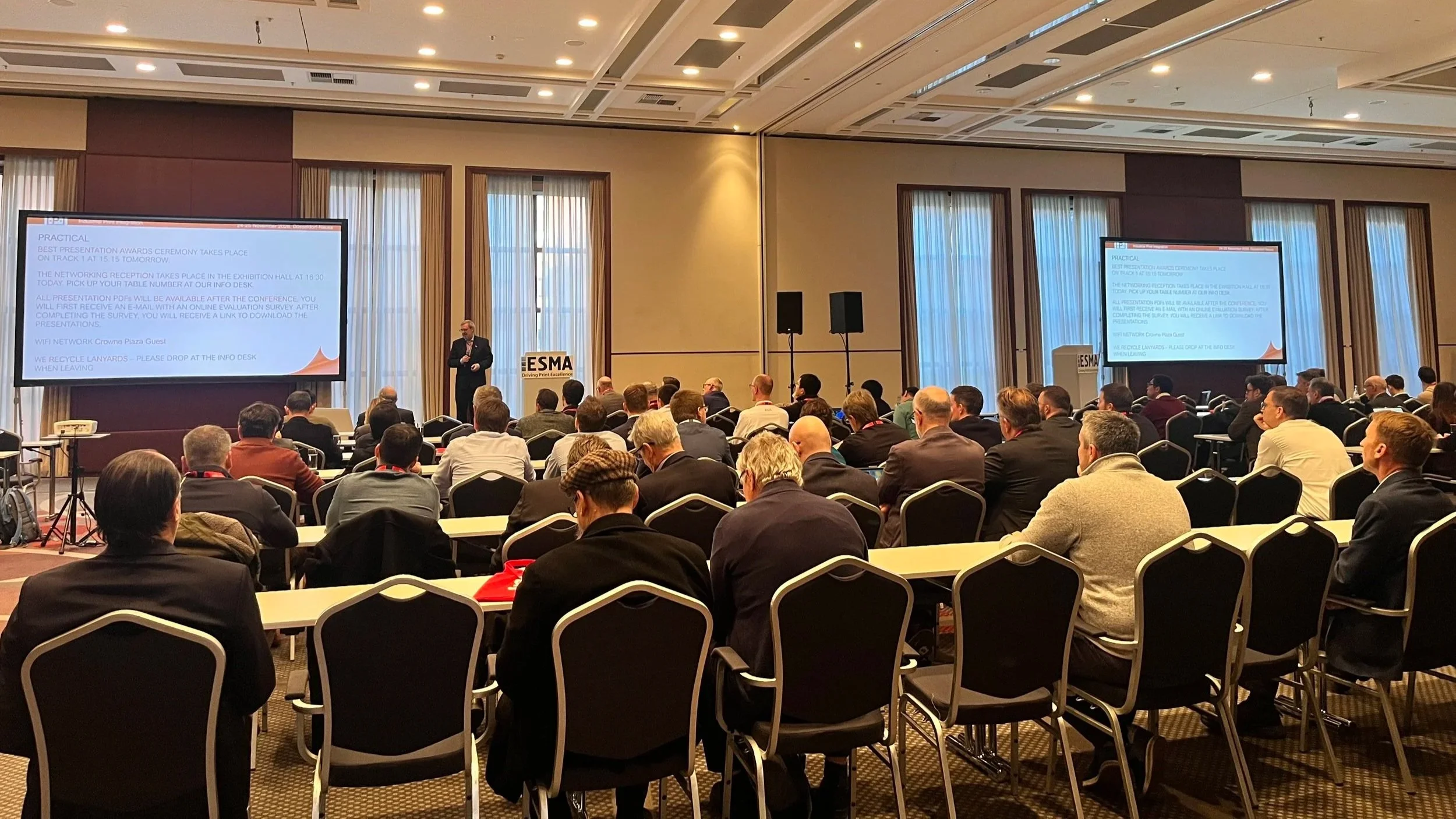
Peter Buttiens, CEO - ESMA
IPI is ESMA's conference for industrial and functional print, and this was its fifth year at the Crowne Plaza in Düsseldorf-Neuss. With more than 60 technical talks over two days, it's a show about making print work inside real production. A big thank you to ESMA and the IPI team for having the FuturePrint editorial team along. The venue is great, and the whole event was very well run. We heard a lot of positive comments from delegates, easy to see why.
A lot of what we heard came back to one issue: getting inkjet to behave once it leaves the lab. ImageXpert and Fiery talked about getting the jetting and the nozzles right. Nazdar looked at what happens when ink meets a difficult substrate, while IST INTECH and Excelitas focused on curing. Then there were the research centres. Hahn-Schickard is using inkjet for sensors, circuit boards and 3D parts, while CRM Group prints on metal and, for most of its work, doesn't use inkjet at all. We finish with a wider view of the industry from inkjet consultant Ramon Borrell. This is just a snapshot. There were far more companies to speak to and talks to attend than we had time for, so here are the people we managed to catch.
ImageXpert
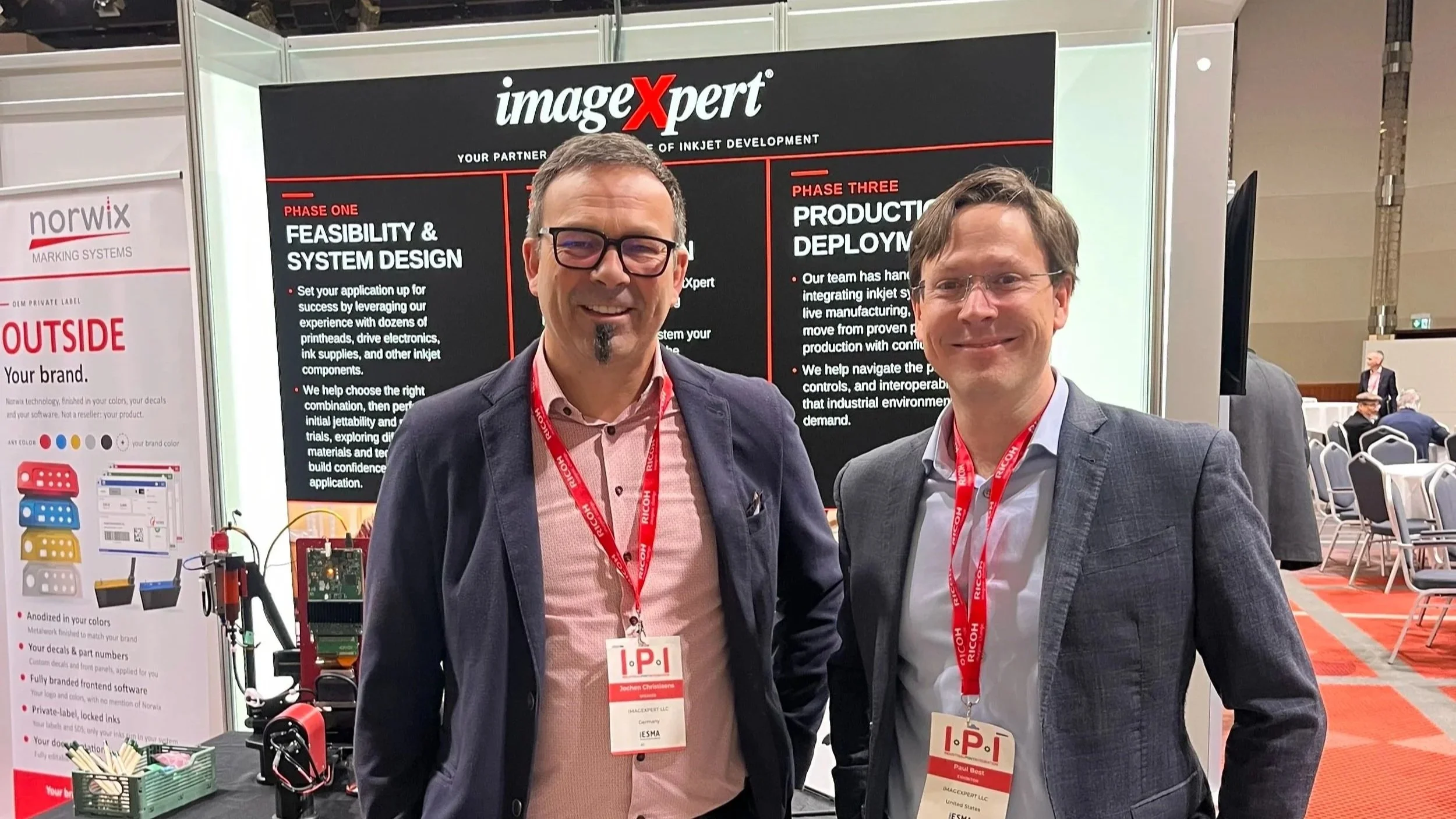
‘It’s better to first try to find out where are the closest parameters that I can change.’
Jochen Christiaens, Regional Manager - Europe, ImageXpert
Most people know ImageXpert for its drop watching systems, and the latest Windows-based version was on show at IPI. The company also builds custom systems for customers, including multi-material jetting and jetting upwards.
In the IPI presentation, Jochen tackled a question every developer faces. When should you go ‘back into the kitchen’ and ask the ink chemists to reformulate, and when should you keep testing process parameters instead?
It starts with drop watching. Sweeping through voltage, frequency and other waveform settings shows where problems such as satellites appear. The aim is a wide tolerance window, because a narrow one will be very hard to keep stable in production. After that come the substrate and longer-term tests on the full printhead.
Only when too many parameters fall outside the window is it time to go to R&D, with the data to back it up. Reformulating can mean starting the jetting work again from scratch, so the advice was to try the parameters you can change first.
Fiery
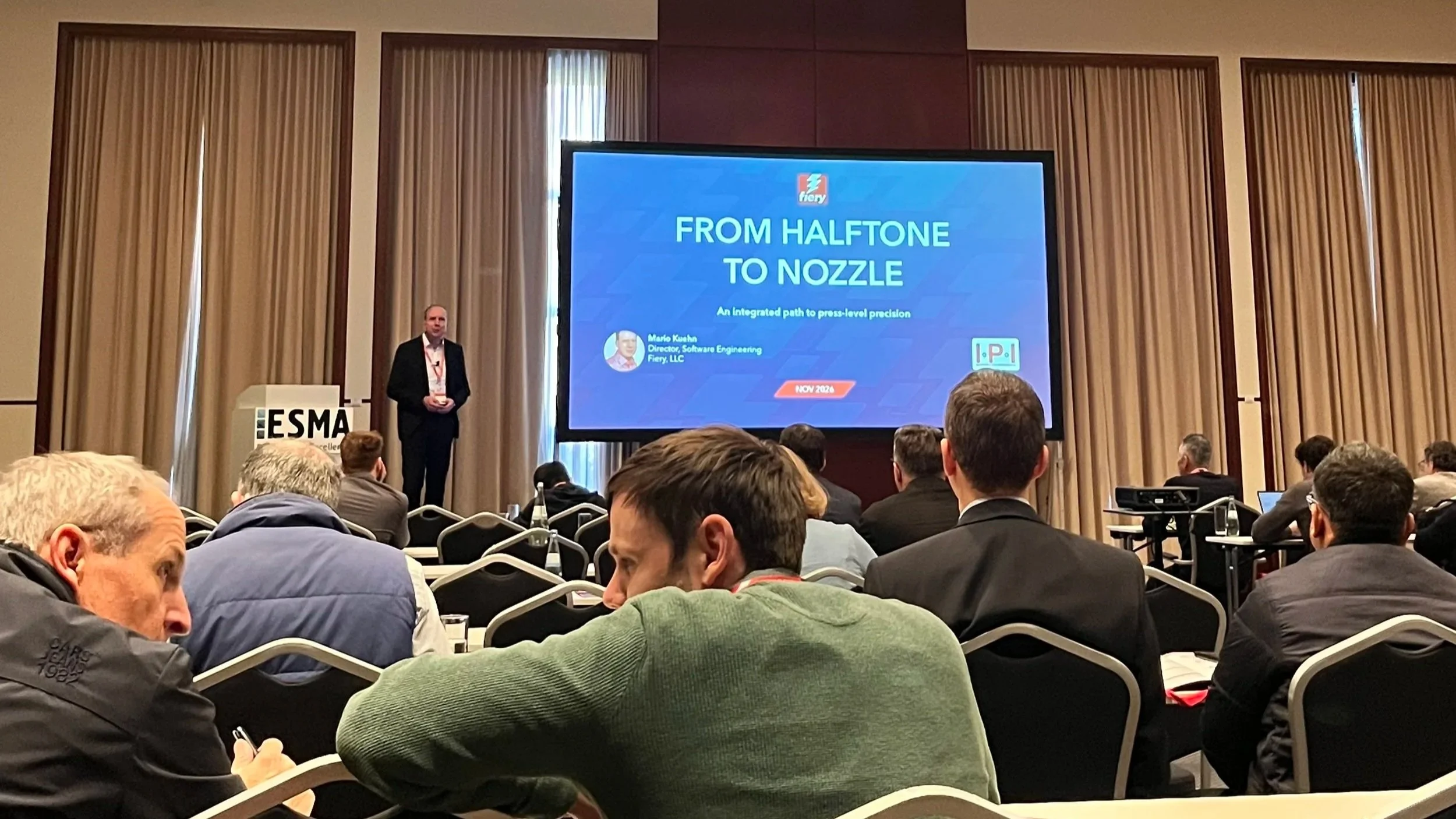
‘So that means we want to have this window, this downtime as small as possible.’
Getting good drops is one thing. Fiery's talk was about what comes next: print uniformity in single-pass inkjet, where every nozzle counts. A single missing nozzle is one point of error, but it shows up across the whole print.
Fiery's view is that the best place to fix this is in the halftoning, inside the DFE, because that's where decisions are made at drop level. With the DFE at the centre, the system can read the press configuration, create the right test charts and send corrections back to the press, without information getting lost along the way.
Correction happens in two stages: first the missing or weak nozzles, then overall density. Mario argued for putting as much as possible into software rather than leaving it to operators, and for keeping downtime short. Fiery is working on batch processing, so all the charts print at once and the operator only has to cut the web once.
Nazdar
Then there's the ink itself. Mark Holbrook's talk for Nazdar, 'Walking the Tightrope', was about designing high-viscosity water-based inks for difficult substrates.
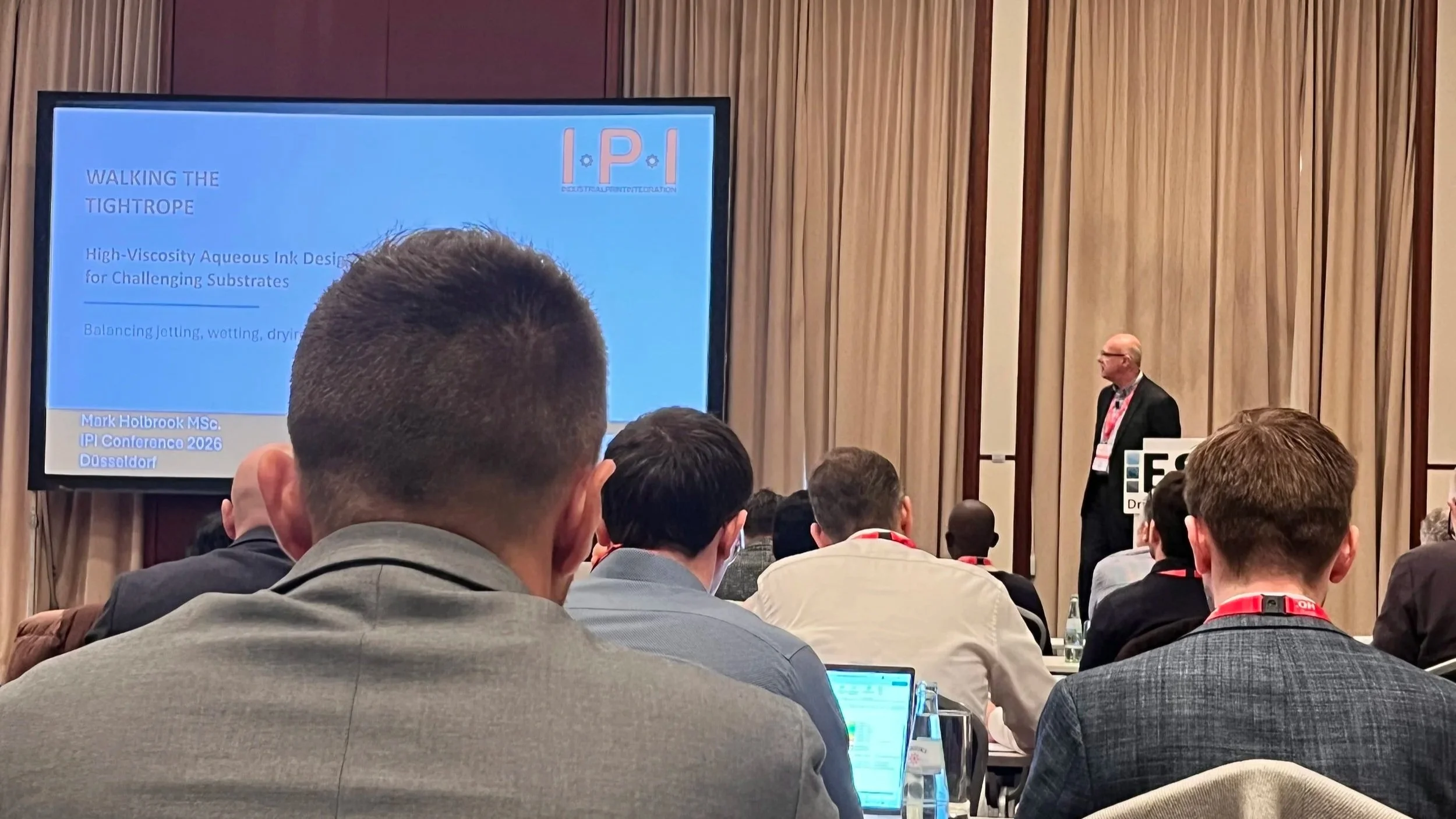
‘Walking the Tightrope’
Mark Holbrook, R&D Scientist at Nazdar Ink Technologies
Nazdar has already shown that higher-viscosity inks can give higher optical density, use less ink and improve print quality on absorbent materials such as uncoated corrugated board. Non-porous and partly porous substrates, used in high-end packaging and industrial work, are harder. Their low surface energy means even a well-made ink can fail once it lands, with problems such as bleeding, spreading too much or too little, and reticulation.
The talk looked at the fluid behaviour Nazdar considers when developing inks for these jobs: how drops wet, spread and coalesce on the surface, and how drying affects the result. The hard part is finding the balance between effects that often work against each other.
IST INTECH
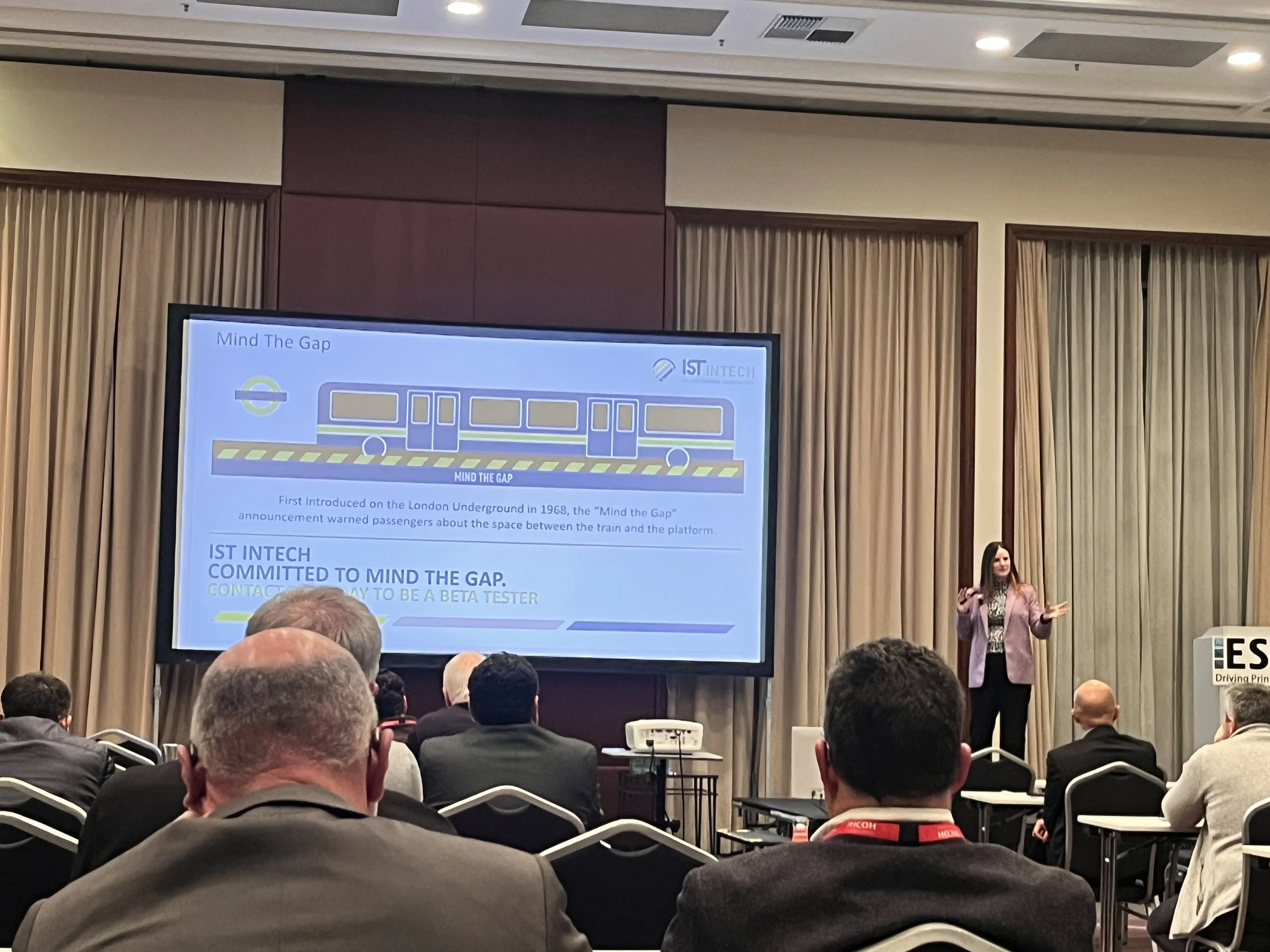
IST INTECH is committed to Minding the Gap
Holly Steedman, Business Development Director, IST INTECH
Holly Steedman, used her IPI presentation, ‘Mind the Gap’, to look at the challenges of integrating LED curing into direct-to-object inkjet printing. Anyone who has been on the London Underground will know the warning. Here, the gap that really matters is the one between the LED and the printed surface.
Printing on a curved surface changes how ink cures. As the distance and angle between the LED and the surface vary, so can the result, which affects surface cure, adhesion, gloss consistency and durability. That makes curing a key part of machine design, and more complex than on a wide-format flatbed, where the light source and substrate sit in a more predictable relationship.
The session covered the decisions involved in building a curing system around a 3D object: optics, beam angle, focal and working distance, and how exposure time, irradiance and dose hold up at production speed. Ink, substrate, thermal management and shadowing all come into it too. Real application examples showed how optimising optical design and curing parameters can improve consistency, reliability and production efficiency.
We previewed the talk before the show: Mind the Gap: LED Curing Integration for Direct-to-Object Inkjet Printing.
Excelitas

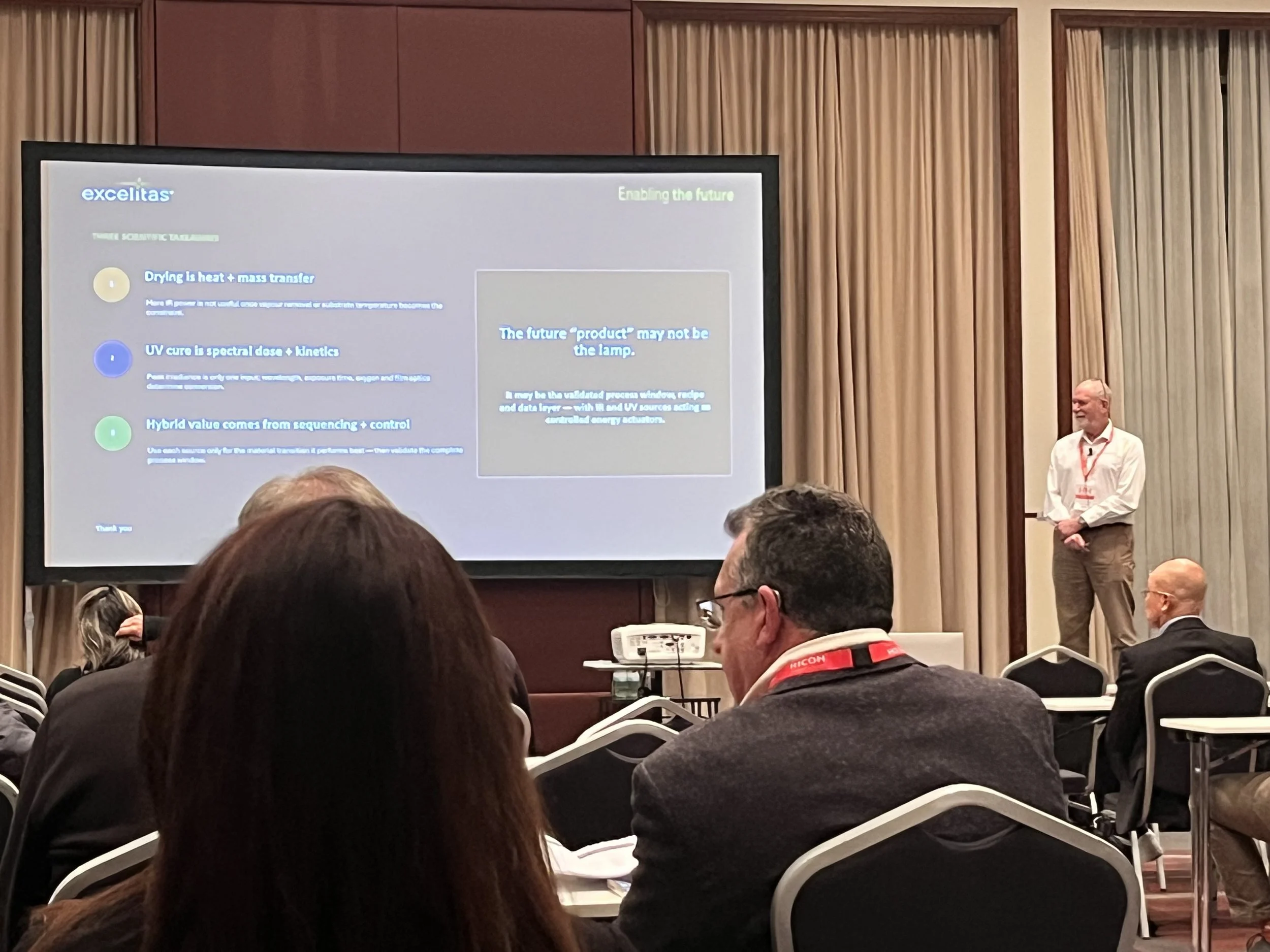
‘You only have 16 milliseconds to do the curing.’ Rob Karsten, Regional Director EMEA
Sticking with curing, Excelitas showed its UV LED curing and IR drying systems on its tabletop at IPI. Rob Karsten’s talk opened with an ‘impossible European specification’. The German engineer wants maximum efficiency, the British buyer wants it at half the cost, the Swiss quality manager wants proof, and everyone wants it 30% faster.
Excelitas’s answer is to combine technologies in the right order. The talk set out a hybrid sequence: IR to preheat, UV LED to pin the ink and control dot gain, IR and airflow to dry, then a final UV cure. The aim is to optimise the sequence of energy and how the material responds to it, rather than the power rating of the light source. With IR drying, for example, vapour builds up under the source, so managing airflow matters as much as adding heat.
Speed tightens everything. In one published example, a press running at around 75 metres per minute with Phoseon FireJet UV LED curing leaves just 16 milliseconds to cure. Looking ahead, the talk argued for model-based control, using sensors and process models to keep a line inside its window. AI can help spot patterns, but it shouldn’t override the physics.
Hahn-Schickard
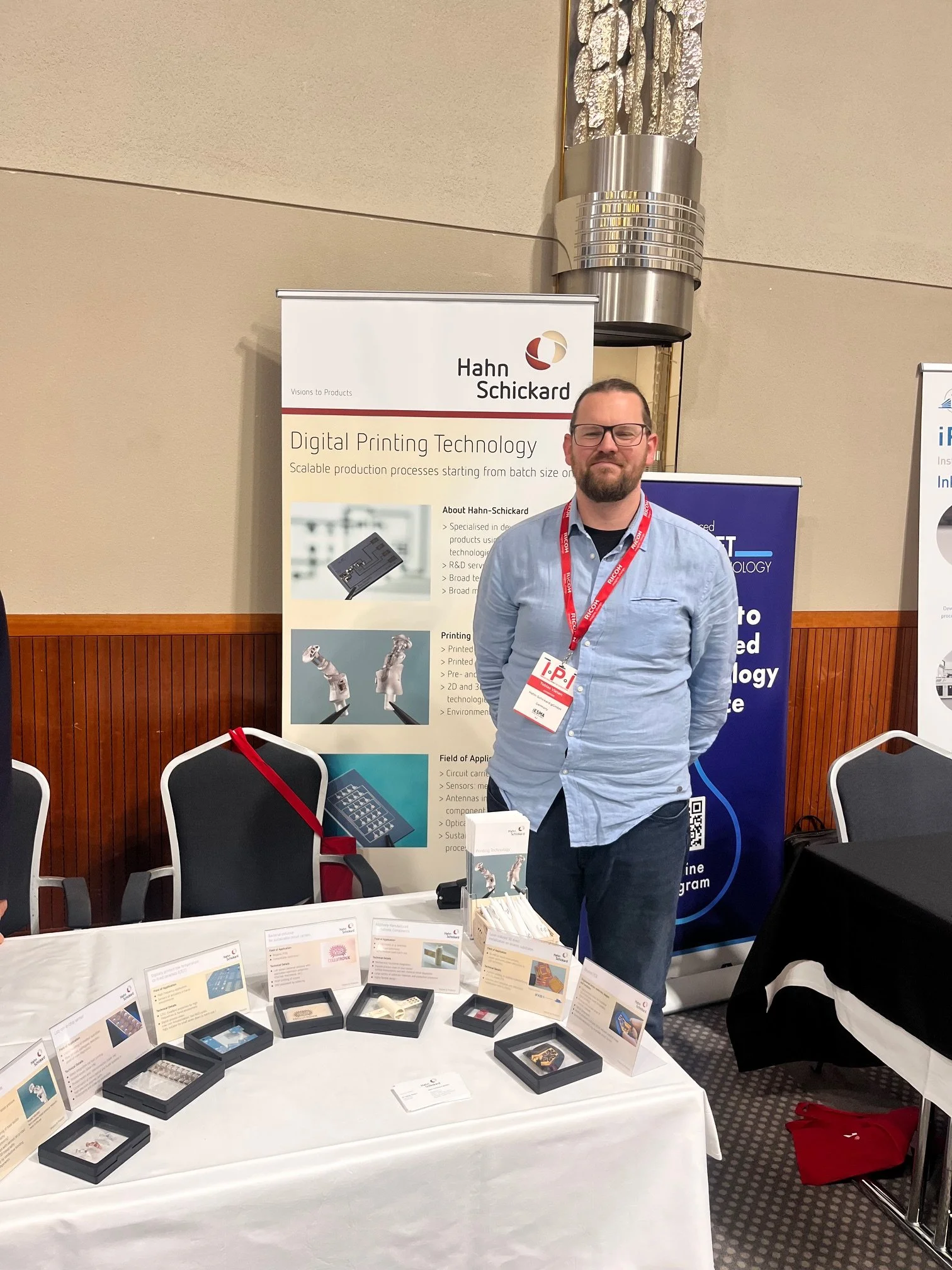
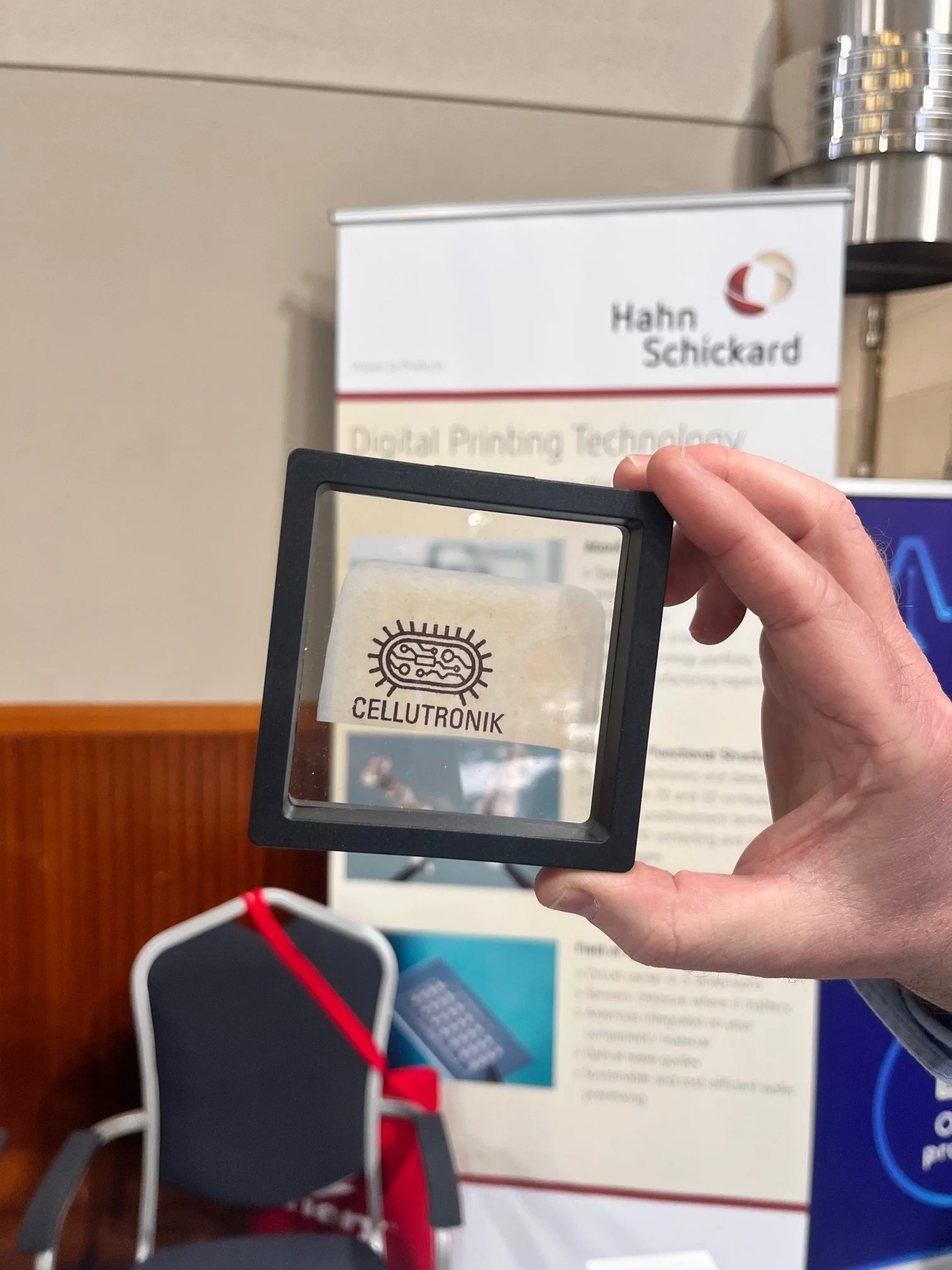
The research centres at IPI gave a glimpse of where things could go next. Hahn-Schickard is a research institute that carries out process and product engineering for customers. Dr Tobias Vieten, Head of Printing Technology, works in its printing technologies group in Stuttgart.
One example was a small injection-moulded part with inkjet-printed electrodes inside its cavities. The gold electrodes are chemically modified to bind specific DNA, so a sample such as blood or saliva can be tested for a virus using impedance spectroscopy. A printed heating element on the back speeds things up.
The group is also looking for alternatives to FR4 circuit boards, with copper inkjet printed onto lab-grown cellulose, the same material that forms on kombucha. It's working on this with a larger German PCB manufacturer. Cost is the hard part, because FR4 is so cheap, but the material is scalable.
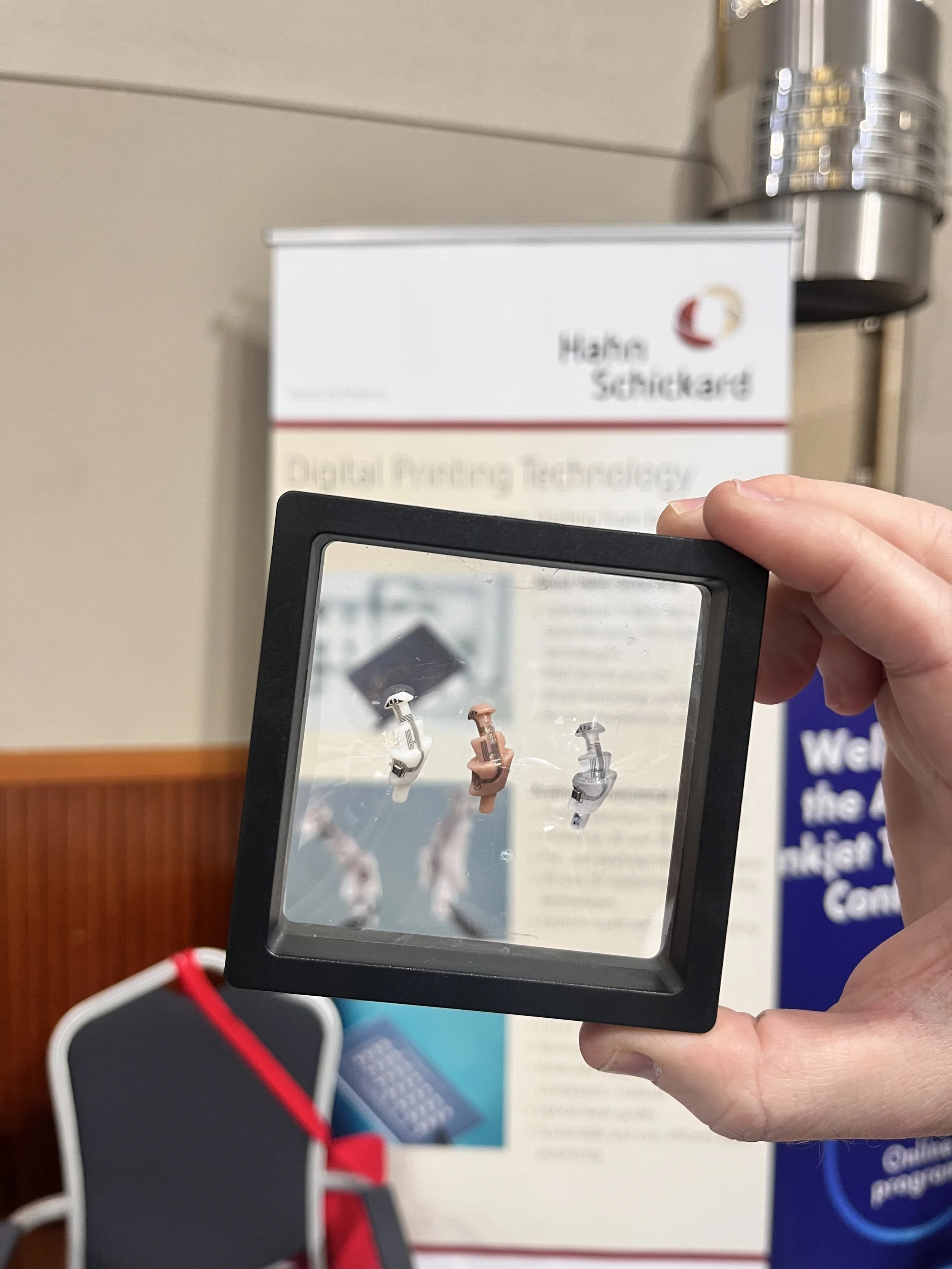
Then there's 3D. One part, shaped to fit inside the ear, was 3D printed and then functionalised with an aerosol jet. It carries a standard Bosch pressure sensor that measures blood pressure from an artery in the ear.
CRM Group
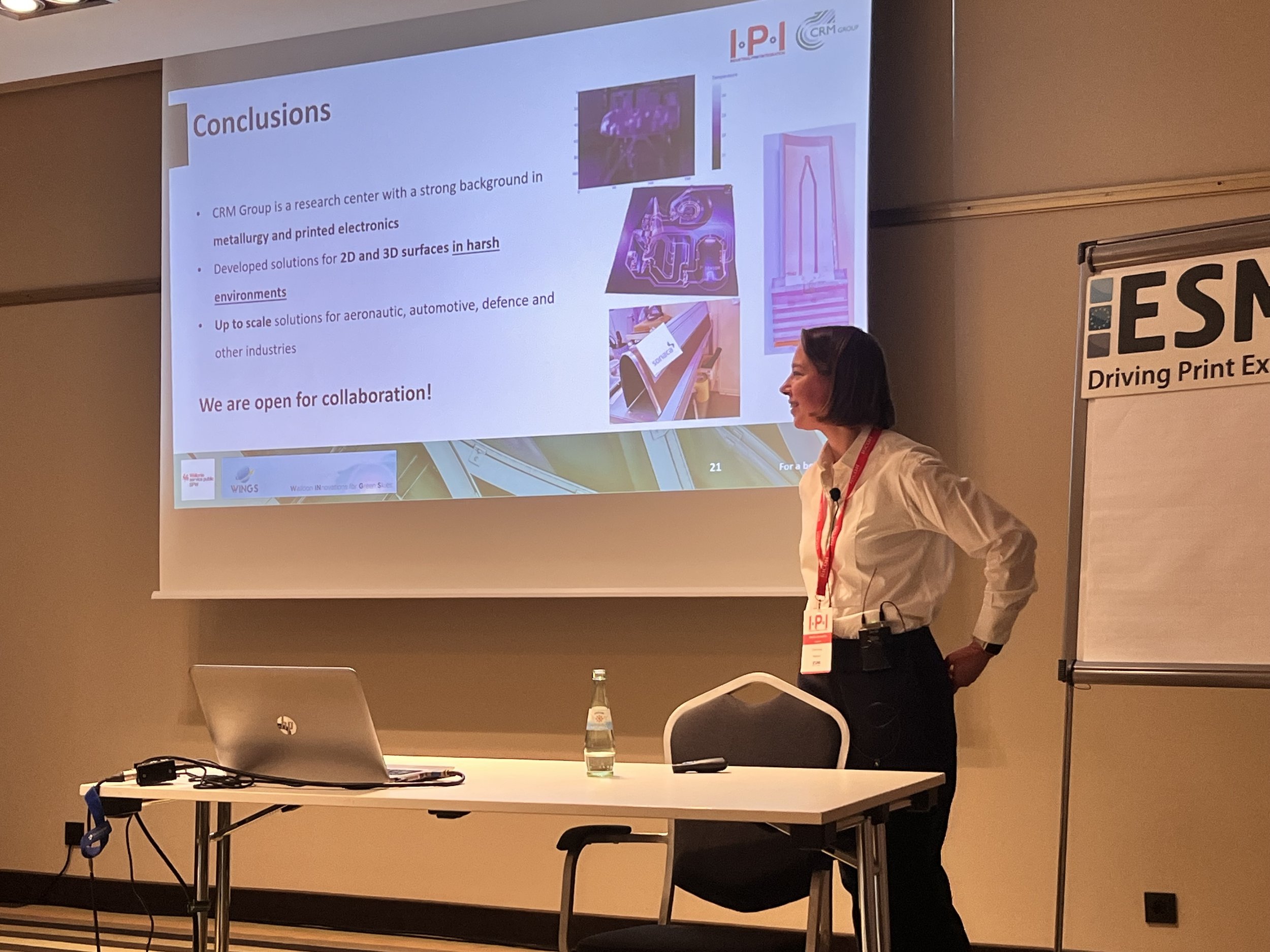
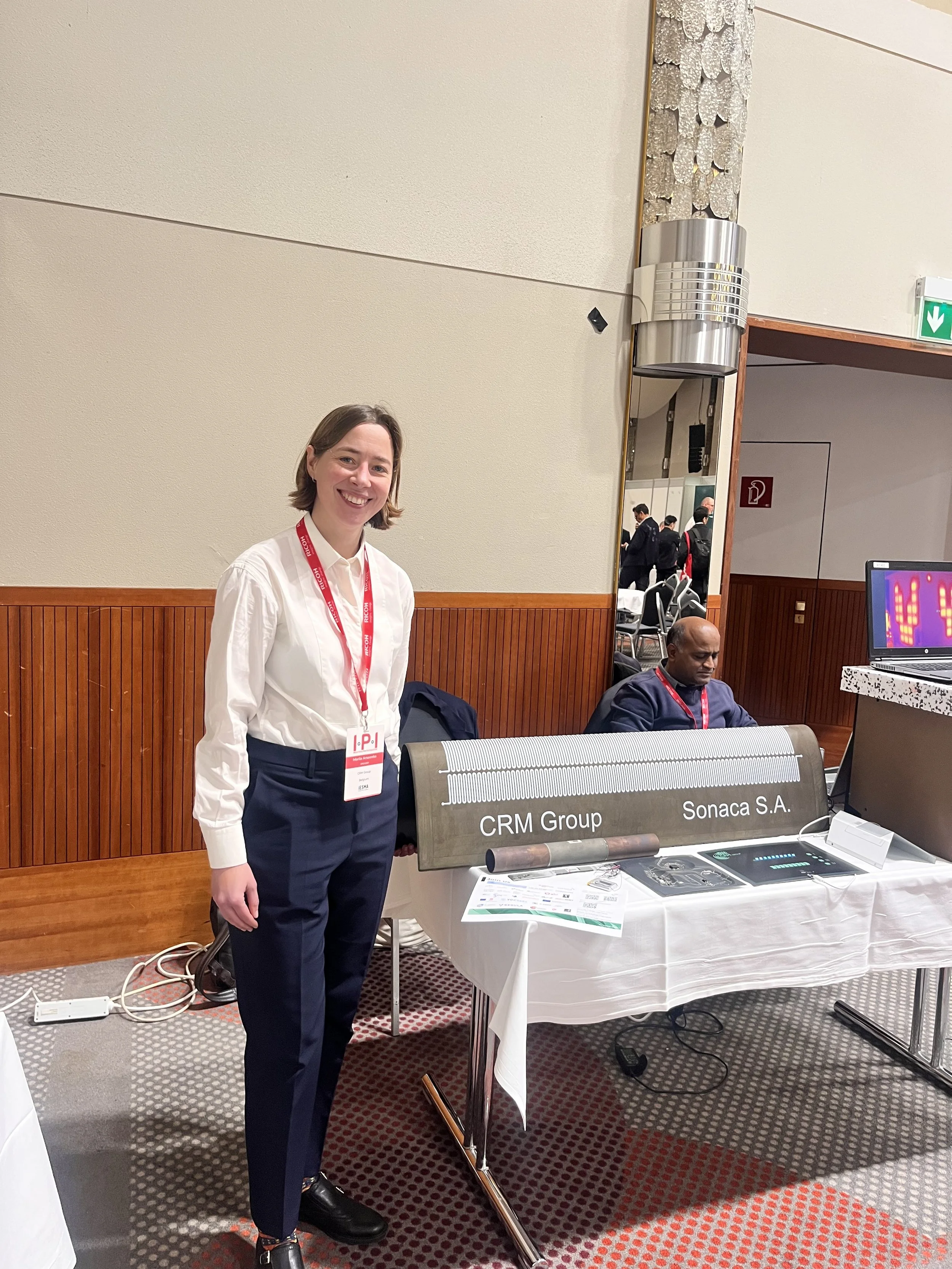
CRM Group was interesting for a different reason: most of what it showed wasn't inkjet. It's a metallurgical research centre, and Dr Mariia Arseenko, Senior Project Leader, works in its functional surfaces department. What makes CRM unique, Mariia says, is that they print on metals.
To print directly onto 3D surfaces, the team uses thermal spray, normally a coating process, adapted for printed electronics. One example was a de-icing heater on the leading edge of an aircraft wing. They have also built grids of individually controlled heaters for a defence client's camouflage system, and printed temperature sensors that work up to 950°C.
Inkjet is in the lab, but the team doesn't really need it. The lines are around 3 mm, which screen printing handles easily, and inkjet may not be optimal yet for large areas. ‘We really don't want to be limited to half metres,’ Mariia told us.
Many of CRM's customers come from metallurgy and don't always think about printed electronics, so conversations often start with what it can do.
Ramon Borrell

‘The issue is how you integrate all these things and take advantage of the opportunity.’ Ramon Borrell, Principal Consultant
So where does all this leave industrial inkjet? For a wider view, we caught up with inkjet consultant Ramon Borrell. He has spent nearly 30 years in industrial and commercial inkjet, at HP, Xaar and more recently Quantica. Elena first worked with him at Xaar, so it felt more like catching up with a friend than an interview.
If you only followed the headlines, you might think industrial inkjet had gone quiet. Ramon sees it differently. The market is moving slowly, but in the right direction. Industrial print is very fragmented, so plenty of projects are working without anyone outside hearing about them. Right now the wave is high viscosity, with some genuine applications close to going mainstream.
How fast inkjet spreads depends on how a market is built. Ceramics took off because a manufacturer could try it on one line and roll it out if it worked. Laminates are dominated by a handful of very large companies, and if they don't see a reason to change, nothing changes.
Automotive and aerospace move slowly for a different reason. Nothing goes into a passenger aircraft without a long list of steps first, and car makers work on such thin margins that they can't afford a failure. They're conservative, Ramon says, but they are doing it. Electrification is where he sees an opening. It's new, so manufacturers have to take some risks. ‘The design is limited by the manufacturing process,’ he said.
The biggest barrier is integration. A company first has to see the advantage, then find a credible way to get there. Get it wrong, and it may not try again for years. Helping companies get it right is now Ramon's job.
Our take
A lot of what Elena saw at IPI was about the work in between: the testing, tuning and integration that make inkjet work in a real process. And sometimes, as CRM showed, the right answer for a job is a different technology. It was good to hear from companies we don't usually get to talk to.
And there's more to come. Our colleague Ed Chesterman is at IPI for day two, so keep an eye out for more stories from the event.
If you'd like to be part of a future roundup, drop the FuturePrint editorial team a line.