
Direct-to-shape grows up: digital is gaining ground across industrial and metal printing
Direct-to-shape used to sit in that familiar category of industrial inkjet talking point: interesting, promising and not quite fully arrived. That is beginning to shift. As FuturePrint’s own conversations in Munich made clear, DTS is no longer being discussed as a fringe capability. It is becoming part of a wider industrial question: how to manage more variants, less inventory, tighter labour conditions and faster change without making production slower, heavier or harder to control.
Ruud Odekerken, Bergstein:
‘We have full control over the complete workflow. This helps to achieve consistent print quality and strong adhesion for different applications.’
That is where Bergstein sees the market moving. The company, known for its single-pass digital printing solutions, argues that the momentum behind direct-to-shape has less to do with novelty than necessity. Manufacturers are under pressure from every angle, and older production logic is beginning to show its age.
‘We see a shift away from purely volume-driven production towards more agile, data-driven and customer-centric processes,’ says Sven Bongartz, Global Sales Manager at Bergstein.
Ruud Odekerken, also Global Sales Manager at Bergstein, makes much the same point. Across industry, he says, the pattern is becoming familiar: more product variants, a broader mix of batch sizes, less inventory, greater sustainability pressure and rising labour costs. ‘Single-pass printing automates a significant part of the workflow,’ he says. ‘It eliminates manual setup and range job changes and reduces dependency on specialised operators.’
Cost tends to sharpen the decision first. Rising material prices, energy costs, labour shortages and inventory risk are forcing manufacturers to re-examine established production models. Flexibility is close behind. Product cycles are shorter, SKU complexity is rising and assortment changes are happening more often. Sustainability matters too, though more often as a force that strengthens the case than one that starts it.
In that environment, DTS starts to look less like a technical option and more like a sensible production response. It turns decoration, coding & marking from a separate production step into a more integrated part of the line. For manufacturers, that means faster response, fewer manual interventions and more scope for variation without operational mess.
Bergstein points to growing demand across industrial sectors rather than one single market. For example automotive components, industrial tools & safety and electrical & electronic components but also the industries like consumer appliances, consumer electronics and the packaging industry are all areas where direct-to-shape is becoming more relevant. In many of the applications, digital is not simply replacing decoration. It is replacing labels, adding variable data and supporting traceability.
Odekerken puts it plainly: ‘We replace labelling and we print direct to the object. ’He also points to the growing role of small print quantities, variable data, including QR codes, barcodes and serialisation. ‘They want personalisation per product,’ he says. ‘That is absolutely also the reason to consider a change from analogue to digital.’
That changes the role of print altogether. A product casing or electrical enclosure can carry serial numbers, safety warnings, product-specific information, region-specific content and customer branding directly on the object itself. One physical part can become multiple digital variants without extra stockholding or a tangle of manual processes.
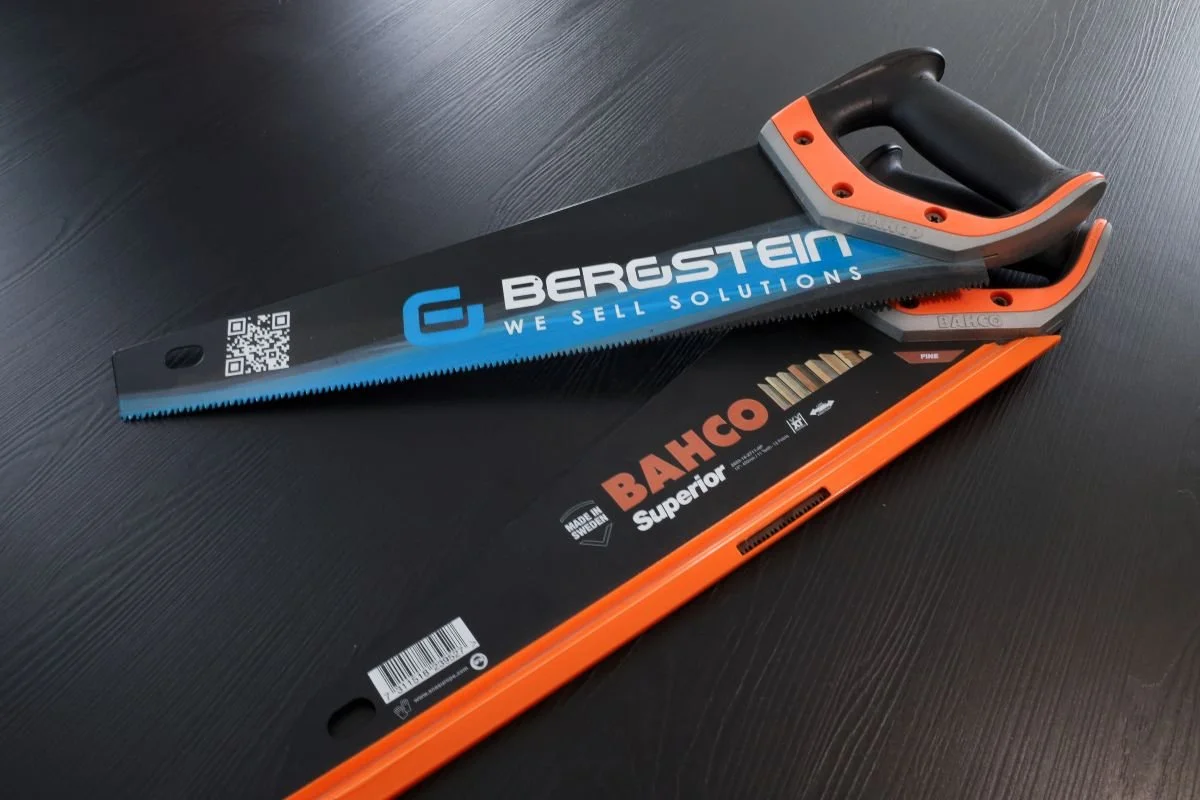
Industrial Tools is one of the clearest examples. Manufacturers of saw blades, measuring instruments and helmets or hats are dealing with more branding changes, more market-specific requirements and more variants. Single-pass DTS allows that information to be applied directly to the product at industrial speeds, turning what was once a fragmented, offline or inline process into something more controlled and more efficient.
Metal sits within that wider DTS opportunity, but it is not the whole story. Bergstein is best understood as a DTS player with relevance to metal applications, not a metal-printing specialist. Still, metal matters because it exposes both the promise and the discipline required.
Applications such as saw blades show the attraction clearly. Durable, functional and branded marking can be applied directly to metal without adding extra production steps. But metal also makes the technical demands much harder to hide. Surface energy, roughness, coatings and oxidation all affect adhesion. Printed content may need to withstand abrasion, heat, chemicals, UV exposure and mechanical stress. In other words, it has to survive outside the demo room.
That is why Bergstein argues that customers often underestimate the complexity of the ink and the printer itself when they begin looking at DTS for industrial and metal applications. The visible part is easy enough to grasp. The harder part is the chemistry, process control and system stability needed to make it repeatable.
This is also where the bigger industrial challenge emerges. It is not only about whether a printer can print. It is whether it can fit into an existing workflow without getting in the way. That helps explain Bergstein’s emphasis on a broader platform rather than a print engine alone. Odekerken describes the strength of the company’s DIGI-Family as the combination of technologies inside a modular platform: pre-treatment, primers, modular build ink systems, curing, software and optional vision systems. ‘We have full control over the complete workflow,’ he says. ‘This helps to achieve consistent print quality and strong adhesion for different applications.’
Software is part of that argument too. Bergstein has put significant effort into its own Bergstein-Print- Manager, designed to connect customer ERP systems and production processes to the print platform. For Bongartz, that is a critical part of the offer. ‘The hardware and the software together in one solution,’ he says, is what allows the printer to work properly inside industrial production.
Standalone systems still have a place, but the market is also looking for more integration-friendly formats. Bergstein’s DIGI-1, a smaller tabletop-format digital alternative to pad printing, points to that next phase. The interest is not hard to understand. Lower-threshold systems are easier to place, easier to trial and easier to picture inside an existing production environment.
Bongartz sees DIGI-1 as a sign of where the market is heading. It is, he says, ‘an easy step’ for companies looking to move into single-pass digital inkjet printing. That is where the argument starts to harden. Pad and screen printing remain deeply embedded in parts of industry, but their limits become more obvious when variation, speed, personalization and data integration begin to matter more. At that point, the case for DTS stops sounding speculative and starts sounding practical. Here also hardware in combination with the right software will bring a new digital chapter to the Bergstein printer family.
For Bergstein, the fastest gains over the next few years are likely to come in industrial tools, electronic components, consumer appliances and packaging. These are sectors where marking, branding, coding and traceability increasingly sit together, and where the cost of inflexible production is rising.
The industrial print market has talked about direct-to-shape for years. Now the pressure is coming from production itself. And Bergstein has the solutions!