
IST Intech’s Holly Steedman reports from PRINTING United 2026 in Las Vegas.
An old saying goes that imitation is the sincerest form of flattery.
Walking around PRINTING United in Las Vegas this year, I started to wonder whether it might also be one of the best indicators that a technology has finally made it.
I have been watching direct-to-product inkjet for a long time. Printing directly onto bottles, tumblers, promotional products, and all manner of three-dimensional objects is certainly nothing new. Companies have been developing this technology for decades.
So I wasn't expecting direct-to-product to be one of the things that really stayed with me after the show. But it was.
Not because there was one new revolutionary machine. There were interesting new machines, but what grabbed my attention first was the opposite: suddenly, machines were everywhere, printing on Stanley cups, tumblers, and game cups. It wasn't just me; I asked a few exhibitors if I was dreaming or if it was a huge increase from previous years, and they all agreed: a huge influx of machines had popped up out of nowhere.
Established manufacturers. New manufacturers. Cylindrical printers. Flatbeds. High-throw systems. Robotic systems. Industrial systems. Entry-level systems. And a remarkable number of lower-cost machines offering various speeds and qualities of direct-to-object print.
You had the original technology developers at the show with large, established stands, and I wonder what they thought, you know, you've made it when people start copying you. But in all seriousness, it would be interesting to investigate it more deeply, and I am sure some are checking for infringements of patented technology.
We know Technologies tend to follow a familiar path: expensive and specialist at first, with a handful of companies doing the difficult development work. Applications emerge, customers recognise the opportunity, and eventually everyone wants a piece of it. You could certainly see that here – at least for simpler geometry products like cups and travel mugs.
Why now? Why did I need to see this at Fespa in Europe? I wondered. Part of the answer may be particularly American.
The US promotional-products market is enormous. Research commissioned by PPAI estimates promotional-product spending at around $50 billion in 2025, including the wider market, within a US branded-merchandise economy valued at $174 billion. That is a lot of potential products to decorate! I am curious what percentage of this would be viable inkjet applications.
These aren't necessarily the promotional products we're used to seeing, like stress balls and pens. Buyers want better design, better materials, recognisable retail brands, and more individuality. Speed and customisation now matter alongside cost, which is, of course, good news for inkjet.
Drinkware is a particularly good example. Tumblers and bottles represent more than 10% of promotional-product sales in the US. In recent years, what was once a practical item you had one of has become something you need in ten designs, a lifestyle accessory. I don't get the trend; how many cups do you need? – But then I am not a coffee drinker, so what do I know. But even I got sucked into it in Austin, Texas, when I visited a Yeta store for the first time- they had just released the new colours. In-store, they could personalise it there, not with print, but with engraving, still a digital process: you make your design there, and a few minutes later you have your own unique cup. So now I have my own for my tea, not coffee, of course.
Stanley, YETI, Owala — the brand matters to people, but the colour matters too, and limited-edition and seasonal designs are also a hot business. Like in Austin, people came to the store that day because of those new colours. I am sure they already had several cups at home. I suppose it makes sense: when everyone has the same Stanley cup, we inevitably start wanting our own, our name, our design, something that feels personal and special to us.
That creates an almost perfect environment for digital direct decoration: no screens or plates, short runs, variable artwork, one-offs and on-demand production. Increasingly, it also means decorating shapes that once were a challenge, or once thought impossible, are now being printed to acceptable print quality.
I noticed something else walking around PRINTING United. The show had a bit of Vegas about it.
Perhaps that shouldn't have been surprising. After all, we were in a city where subtlety is not in its vocabulary.
Neon, colours, Varnish. Texture. Raised effects. Metallics. Embellishment. Everywhere I looked, a printed product seemed to shine, spark, or pop—Vegas all around.
But what was interesting was that this wasn't confined to luxury packaging, premium labels or high-end commercial print. I saw the same on promotional products and direct-to-product decoration.
Mimaki's UJF200 series, introduced at the show for promotional goods and industrial product decoration, was a good example featuring newly developed fluorescent UV inks. Direct-to-product meets fluorescent colour—very Vegas.
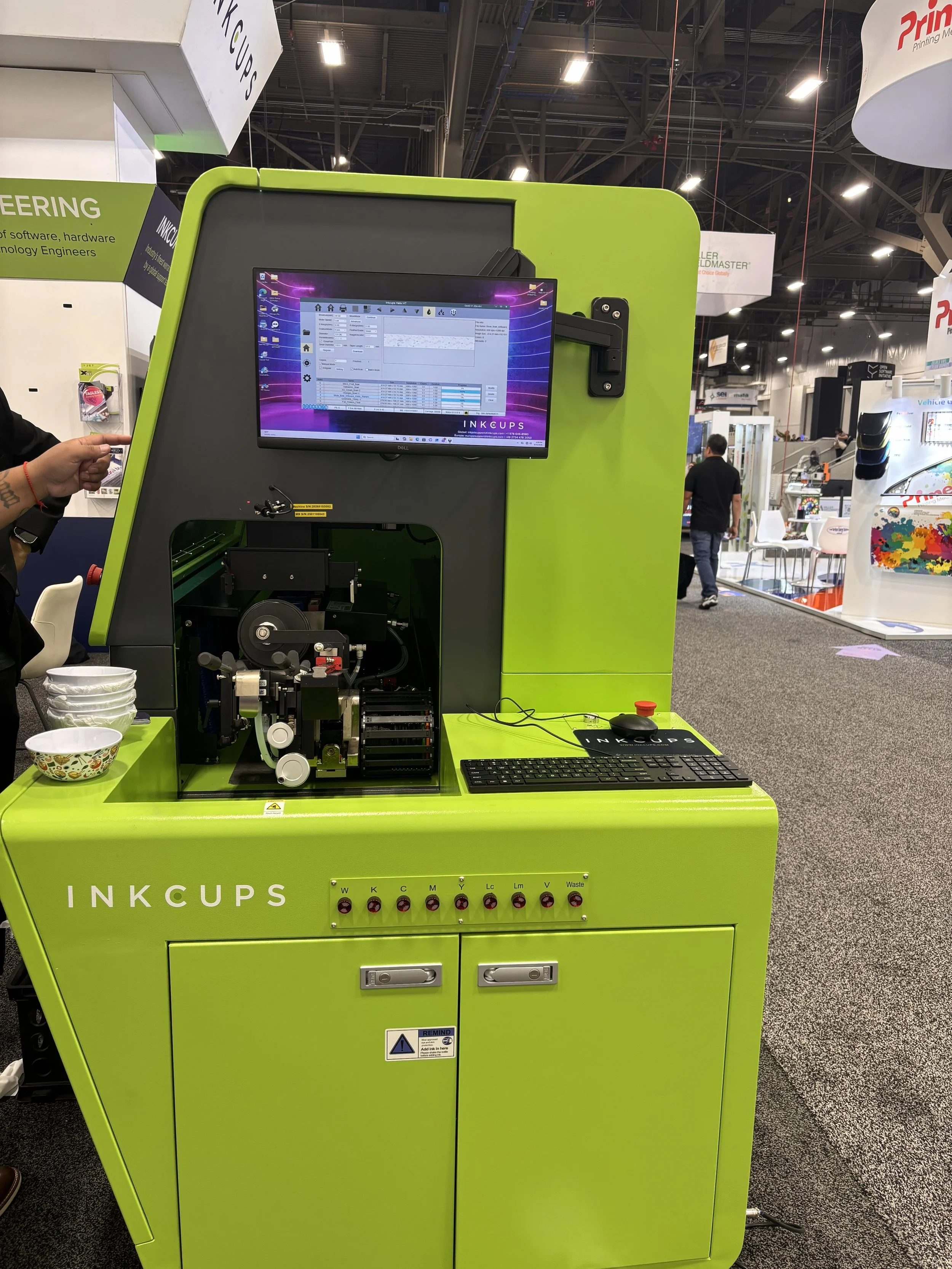
InkCup’s new Helix® High Throw UV Cylindrical Printer
For years the digital-print industry has talked about personalisation. That conversation often ends with someone's name on something. A strong gimmick, certainly, but I think that is nothing new for consumers and has lost the freshness of early campaigns like the famous Coke Cola names. But today it feels like imagination is coming into it; finally, designers are utilising the full opportunities for inkjet printing: fluorescent colours, texture, raised-texture varnish, limited-edition artwork, unusual colour combinations, or fully decorated, complex three-dimensional objects. You can see how consumer trends and people's desire for individuality influence this market.
Cheaper at one end, cleverer at the other. On the machine side, direct-to-product seems to be moving in two directions at once.
At one end, it is becoming more accessible. The influx of lower-cost systems at PRINTING United was difficult to miss. For promotional-product companies, small decorators, and businesses adding customisation, there are now even lower-cost options, but what about the quality, reliability, and service of these systems? You risk ending up with a machine that lasts only a short time. I am a big believer in the "buy cheap, buy twice" motto.
On the other hand, established OEM printing technology is becoming considerably more sophisticated. Inkcups launched the new Helix® High Throw UV Cylindrical Printer in June 2026, which can print at a 15mm print gap, a huge advantage when decorating irregular shapes with varying throw distances; they showed this with a conical bowl Print on the stand.
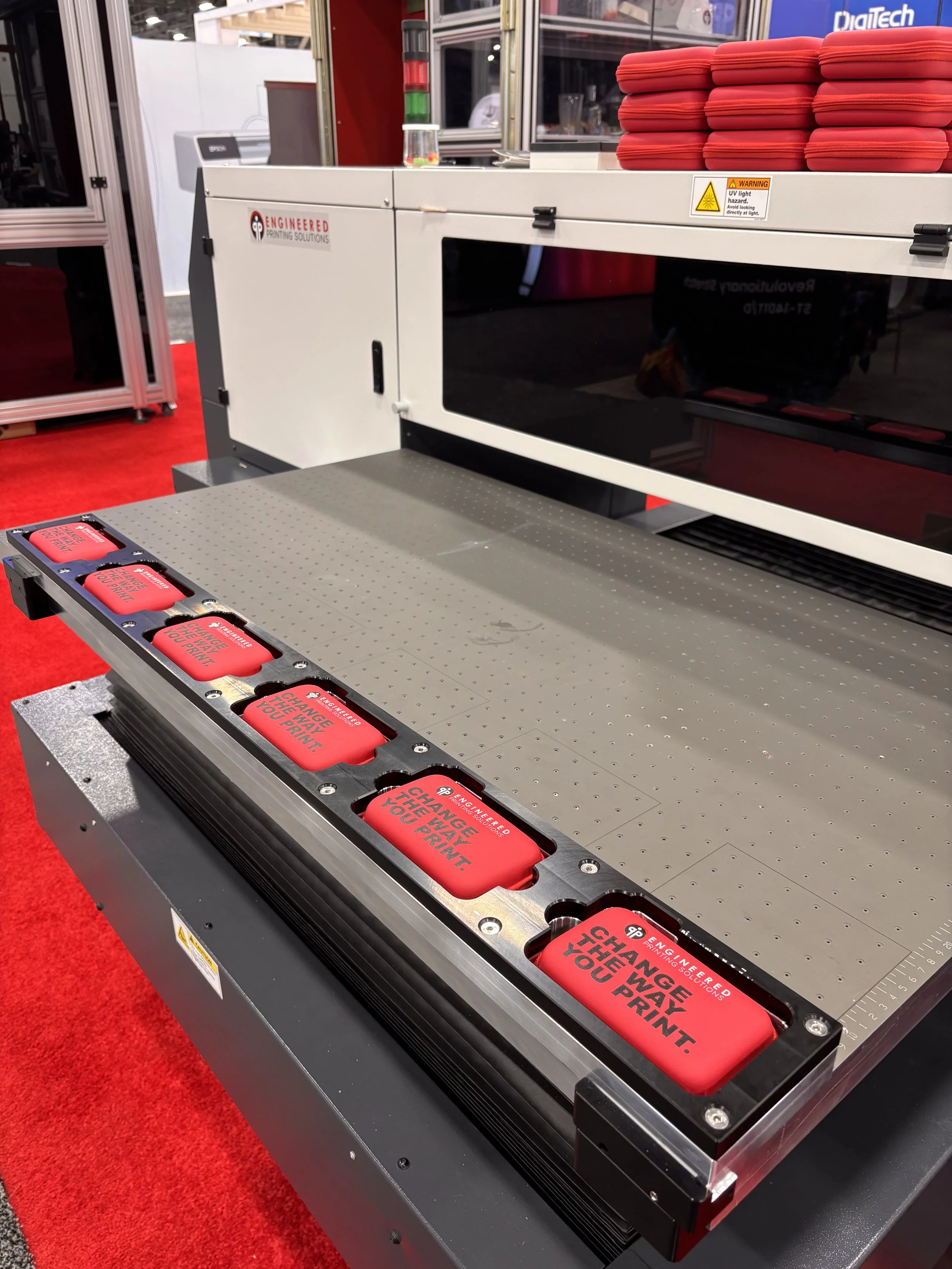
EPS system on show
With its wide range of systems, Engineered Printing Solutions (EPS) showed that any application is possible, with a full spectrum of automation for the whole production process and a wide range of multi-pass, single-pass, and robotic approaches. EPS is also Epson’s new North American partner for the CONTOURJET launch, a strong example of robotics in direct-to-shape decoration. Epson developed the robot, and the machine features the Epson PrecisionCore S800 Printhead and advanced image processing that enables decoration of complex curved and irregular surfaces.
Roland's range stretched from flatbed direct-to-object to cylindrical and higher-volume production. They launched two new printers, the VersaObject IO-300 for direct-to-object, which featured the classic flatbed design for use with jigs. They also launched a dedicated Cylindrical Printer, the VersaObject RC 300 Series, aimed at shirt runs and premium customisation. On display was also the higher-volume option from their partner, LSINC: the periQ 360.
It didn't stop there; more US-based companies caught my eye. Innovative Digital Systems (IDS) also showcased a high-gap printer, the Prisma Z-Max Pro, and had the best sign, which conveyed the flexibility of inkjet with the slogan, "Can we print it?" – Yes, we can!
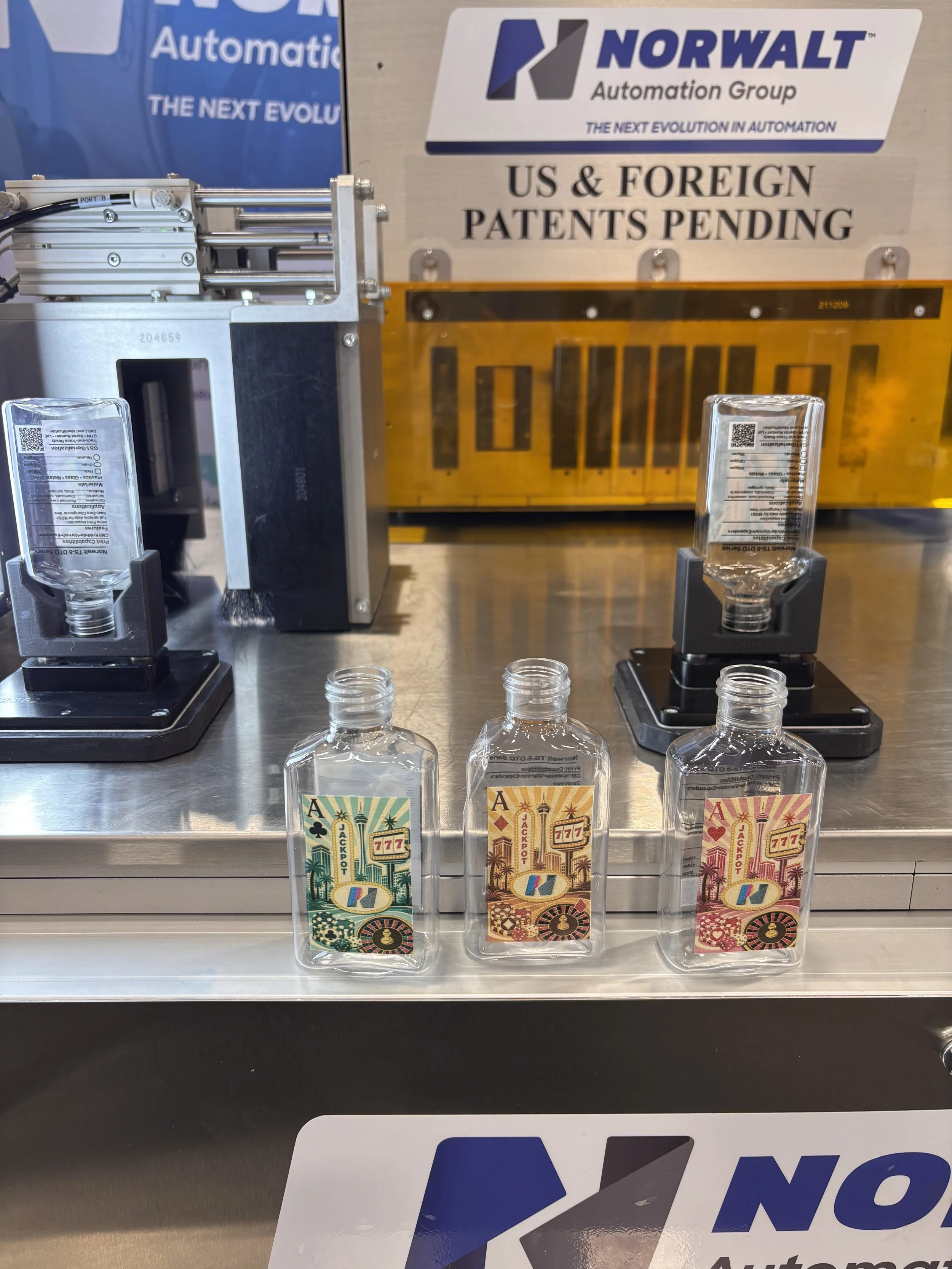
Norwalt’s Tesseract system
Another interesting company is Norwalt; they have moved from automation into printing, which, for me, is a huge advantage. They understand product handling and automation and can focus on bringing inkjet into those processes and high-output environments. They demonstrated their Tesseract system, which utilises Beckhoff's Xplaner Magnetic planer transport technology, allowing individual products to move and rotate dynamically through the decoration process. This also allows easy combination, for example, direct-to-print but also a labelling application.
So while the lower end is becoming increasingly crowded with low-cost systems, the upper end is pushing into automation, complex shapes and industrial production. Standing apart from the influx of these systems is the technology knowledge and know-how they have built over years of developing these applications.
CyanTec from the UK also showed their robotic single-pass system. But it is not just for promotional products; it is also for industrial applications. I spoke with Clayton Sampson about what made him come over and invest in the show; he said there was strong interest across a range of applications, and he saw a market gap for a machine that can be programmed to print on unique parts at this quality-vs-cost level.
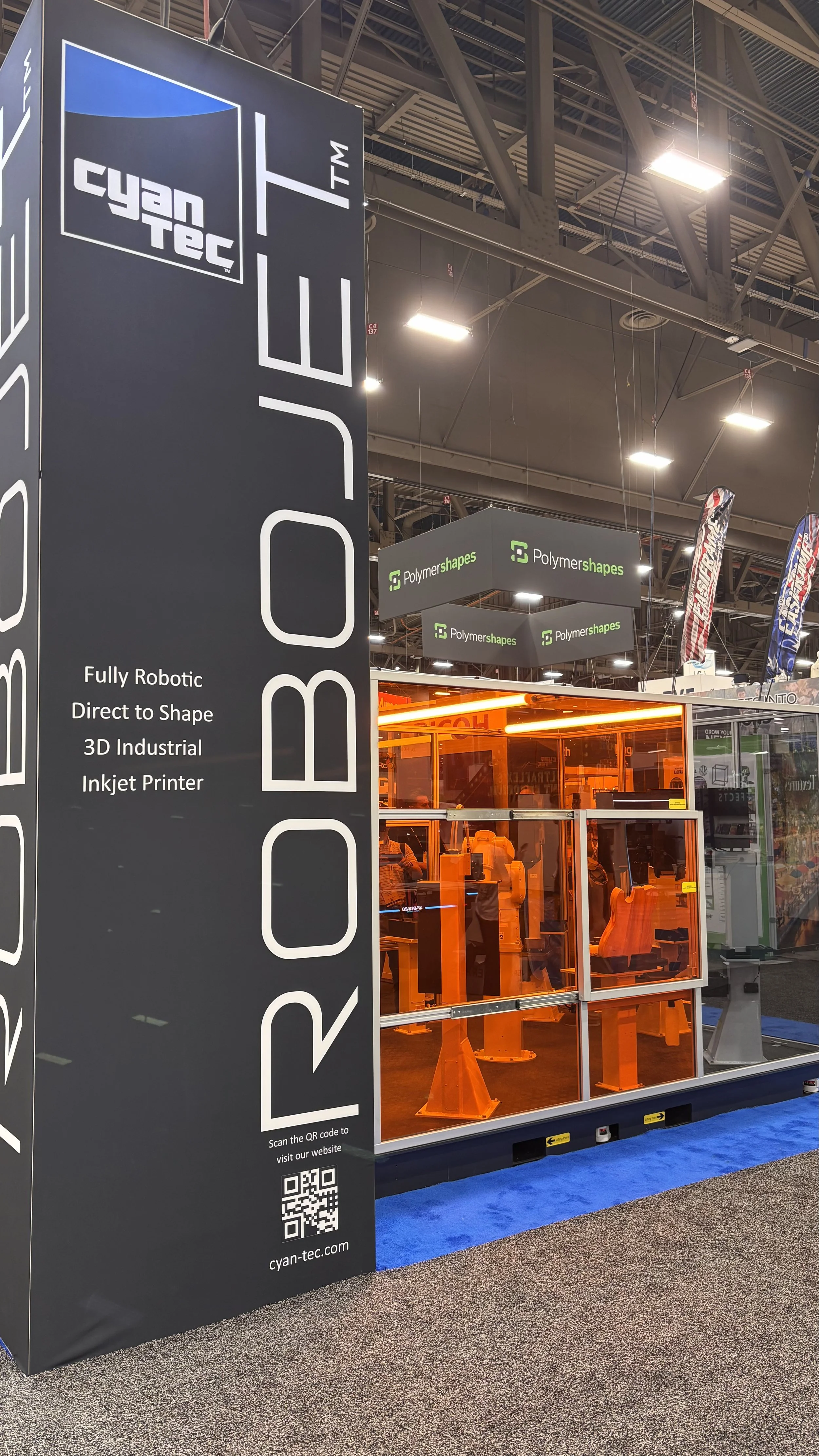
So I think the strong story of inkjet also adding value came through here, too: it goes beyond decorating a simple tumbler; you can see that at the show, once you look past the influx of low-cost systems. It makes you appreciate how far the technology has come.
The embellishment story reinforced that feeling for me also. PRINTING United introduced separate embellishment tours for digital production and wide format, with the digital production tour reportedly selling out before the show opened. Seems I wasn't the only person looking at all the shiny things.
Much of the industry's technology conversation focuses on taking cost out: automation, AI, fewer manual steps, faster setup, less waste. All important; I saw that influence at Fespa and wrote about it. But profitability has another side. How do you add more value to what you're selling, and is the packaging embellishment worth what you get back? Especially in the US market, the range of products and choices is huge; I remember my first time visiting supermarkets in the US and being overwhelmed by the options. Design is a key factor for products on a shelf, and research shows consumers are influenced by packaging's look and feel when making purchasing decisions.
An undecorated tumbler has one value. Add a logo, and it has another, but no one goes crazy about logos. Give it a unique design, special colour, texture, or individual detail—something the recipient actually wants to keep —and it creates more value. The same is true for packaging people photograph and share on social media, for example, creating advertising and hype around a product.
That's especially true for promotional products, where the item must do two jobs: carry a message/brand and be desirable enough not to end up in a drawer or the bin when you get home. Your company logo on the side may not be memorable enough these days.
A tipping point? I am sure many of you have read the Malcom Gladwell book
I am always slightly wary of declaring that a technology has reached a tipping point. Our industry has had plenty of tipping points over the years, but some inkjet applications took another decade to tip. They seemed to teeter on the edge, or hang on for dear life.
But something did feel different to me at PRINTING United. Direct-to-product isn't new. Personalisation isn't new. Fluorescent inks aren't new, and neither are promotional products.
What felt different walking around Las Vegas was how all those things were converging: a huge market for branded physical products; consumers seeking individuality; digital decoration becoming easier to access; sophisticated printing systems taking on more complex shapes; and designers embracing the inkjet technology with the special colours, texture, and effects.
Maybe the next phase of digital product decoration isn't simply a low-cost giveaway or a forgotten gimmick. It's about turning a product into your own. This is becoming increasingly important now; you can debate whether that is a good thing. Interestingly, I am reading a book right now called Peak Human: What We Can Learn from the Rise and Fall of Golden Ages; it talks about the looking glass (mirror) and how it started a trend toward individualism in Renaissance Italy. This changed society and made people more self-aware, and thus more self-focused, than ever before, as mirrors made people observers of themselves for the first time. As social media has developed, it has become, for many, a supersized looking glass, allowing us not just to see ourselves but to construct an image for others to see and gauge the reaction to it. That has influenced consumer trends, which drive many aspects of the printing world and its applications.
And perhaps Las Vegas was the perfect place to notice it. In a city built around standing out, you only have to walk a few minutes on the Strip to see how everyone wants to be unique. But what really makes us unique? I will say it is not your Stanley cup for sure, so don't forget that. But if print makes people happy and feel special, that is not a bad use of technology.
Till next time, crazy Vegas
-Holly
