
Direct-to-Shape Inkjet: How Cyan-Tec is Shaping Advanced Manufacturing
We visited Cyan-Tec to gain a deeper understanding of direct-to-shape printing and how it is being applied within the inkjet sector for advanced manufacturing. As industries continue to move towards greater customisation, shorter production cycles, and more complex component geometries, technologies like direct-to-object printing are emerging as a practical alternative to traditional flatbed or transfer-based methods.
At the heart of this approach is the ability to deposit ink directly onto three-dimensional objects, opening up new possibilities for branding, functional coatings, and high-precision decoration across a wide range of materials and shapes. Our visit provided insight into how systems such as the Robojet printer integrate surface preparation, controlled ink application, and robotic motion to achieve consistent, production-ready results in an industrial setting.
“Something born in three dimensions needs to be printed in three dimensions.”
At the centre of the workshop is Cyan-Tec’s Robojet printer system, designed to print directly onto three-dimensional objects rather than relying on flat substrates. Unlike conventional printing methods, the process is engineered to accommodate complex geometries, enabling high-quality graphics and finishes on curved, irregular, or fully formed components.
It is a very particular process, as Clayton Sampson of Cyan-Tec explains: “Something born in three dimensions needs to be printed in three dimensions.”
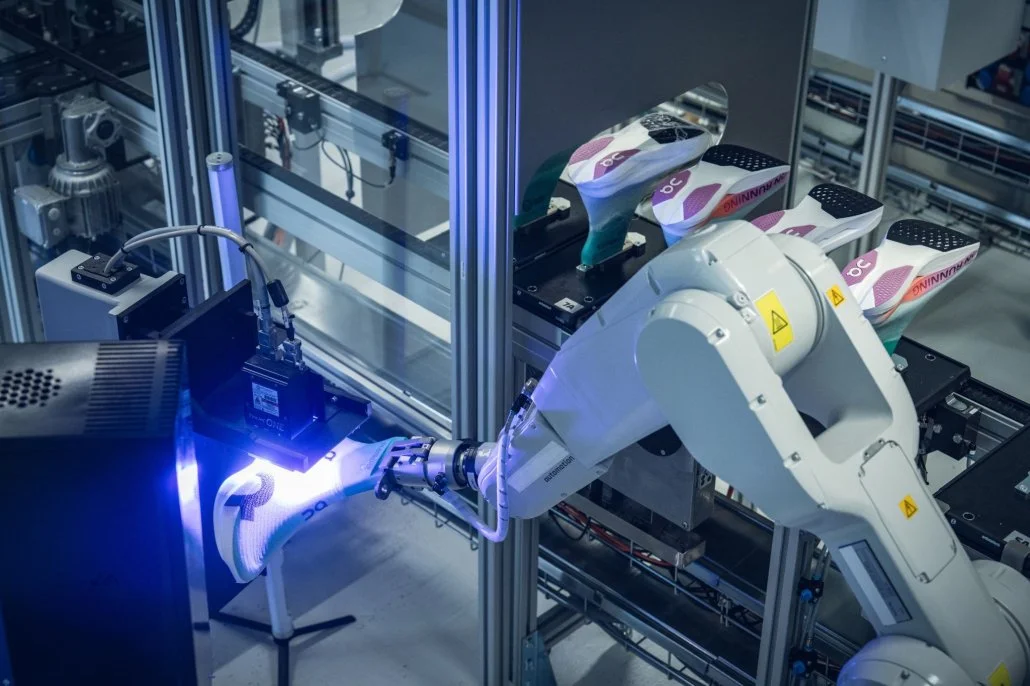
Cyan-Tec’s Robojet in action
The Robojet process begins with plasma treatment, a surface preparation stage that modifies the material at a microscopic level. By energising the surface, it increases surface energy and improves ink wettability, ensuring that the ink can properly adhere rather than bead or lift. This step is particularly important when working with challenging materials such as plastics, where adhesion is not inherently strong.
From there, printing takes place in carefully controlled stages. The ink is partially cured during application — a process known as “pinning” — using UV light to stabilise each deposited layer. This allows subsequent layers to be added without smudging or distortion, making it possible to build up intricate multi-layered designs and combine multiple colours with precise registration. Depending on the complexity of the design, the system may perform several passes over the object, constructing the full image or pattern.
Once all layers and colours have been applied, a final full UV cure is carried out using LED technology. This step solidifies the ink completely, ensuring durability, abrasion resistance, and long-term adhesion. The result is a finished print that is ready for handling immediately, whether it is monochrome or full colour.
The whole process is great to watch. The robot arm pirouettes with precision, carrying and reorienting each object as it moves, twisting and contorting it beneath the printer head so that every surface can be reached with exact alignment. Confined within a compact 2 by 2 meter casing, the Robojet is designed to slot neatly into a production line, delivering consistent, repeatable output, with each object taking around three minutes to complete.
