
Buskro Returns to Europe with a Modular Approach to Industrial Inkjet
The Canadian family engineering firm is marking fifty years in business by bringing a new print module, and a wider platform concept, to European packaging customers.
Buskro has a long history in Europe, built on direct mail and transactional printing and on the trust of market leaders who relied on it to handle high-speed variable data. As those markets evolved, so did the company. It kept developing products, software and controls for customers in Canada and the United States, and extended the platform toward packaging, RFID and other industrial applications. It now returns to Europe with a new print module called Argo and a wider platform concept it has named the Argo-Verse.
On this week's FuturePrint podcast, Frazer Chesterman spoke to Frank de Jonge, Sales and Marketing Director for Buskro Europe, and Kyle Kropman, third generation of the family behind the business.
Fifty years of continuous development
"We've never really stopped growing and developing," Kropman says. "We didn't stop listening to that European market." He puts the company's longevity down to exactly that and is clear that this return is not an attempt to recreate what Buskro did twenty years ago. European conditions have changed, with shorter runs, more product variation, traceability requirements, labour constraints and a need to fit digital capability into lines that already exist.
De Jonge, who describes himself as an inkjet enthusiast after around twenty years in the technology, argues that the engineering behind Buskro is easy to underestimate from the outside. The company develops its own front-end software for high-speed variable data, along with its own controllers, printhead drivers and mechanical systems. That matters, he says, because industrial printing problems are rarely solved by the printhead alone. Ink chemistry, data, motion, product handling, sensing, drying and integration all have to work together as one system.
Why the market needs another system
The market already has plenty of digital presses and plenty of inkjet integrators, and both guests say that was the first question they put to themselves.
"We didn't feel like the market was really looking for another big, closed machine where the customer might have to change their process to fit the equipment," Kropman says. One customer needs monochrome variable data. Another needs full CMYK. A third needs to print vertically onto a conveyor they already own. Fitting all three into a single architecture means either overbuilding the machine or compromising the application.
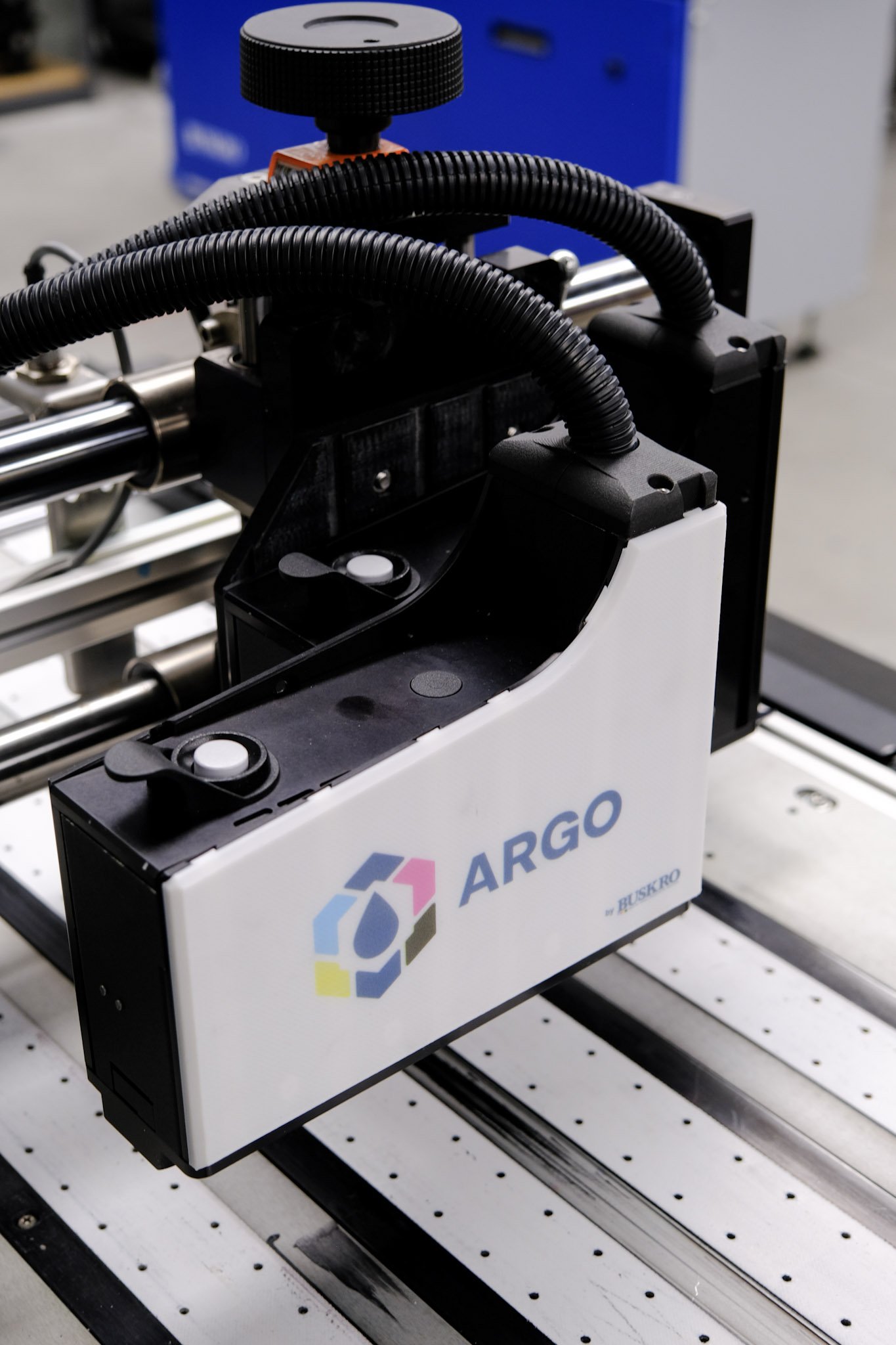
The Argo
De Jonge says Buskro starts instead with the production requirement, covering substrate, print width, colour, orientation, speed, data, available floor space and what already exists on the line. The system is then configured from common building blocks. "The customer should not pay for functions that don't create value," he says, "but should also not be trapped when the requirements change or evolve."
What the Argo-Verse means
Both guests use a LEGO comparison, though de Jonge is quick to qualify it. The industrial version of the idea depends on standardisation, with every building block sharing defined mechanical, electrical and software relationships. "It's not a box of unrelated accessories," he says. "It's a platform designed so that the pieces are intended to work together."
Argo is the first module within that architecture, a 4.25-inch print unit. Modules can be combined to widen the print area, reconfigured between monochrome, two-colour and CMYK, and reoriented for top, side or angled printing. An 34-inch / 864 mm-configuration can be split into eight 4.25-inch units by sliding the heads apart. Around the print node sit the other functions a production line needs, including data handling, RFID and identification workflows, transport and drying.
Kropman is clear that modularity does not mean handing customers a crate of parts. "Buskro and our partners worldwide are still going to be responsible for engineering and validating the solution for the customer. The difference is that we have a common architecture to work from rather than starting from scratch every time."
Drying and the adphos partnership
The collaboration with adphos illustrates what the company means by "Verse". On porous materials and with water-based inks, drying can determine speed, print quality, substrate-compatibility and footprint, and it is often added at the end of a project rather than designed in from the start.
Buskro is working to bring an adphos drying module directly into the Node. "Rather than treating drying as something we figure out after the printing system is built, we want the two technologies to work together as part of the application," de Jonge says. The same applies to vision inspection, data-management and material handling specialists, whose modules can sit inside the architecture rather than outside the solution.
Price and early evidence
Large industrial digital presses can require multi-million-euro investment, and de Jonge names that as one of the barriers keeping price-sensitive packaging markets from moving to digital. Argo is aimed at a different entry point, with a target of below €50,000 for an entry system, subject to final configuration. Affordability is not simply a cheaper press, he says. "It's about avoiding unnecessary capex, floor space, and complexity."
Asked whether there are Argo customers to point to, Kropman says there are not, and that it is worth being upfront about it. What Buskro does have is fifty years of engineering, an installed base of industrial and variable-data systems, and a prior packaging project involving a two-dimensional carton printing and labelling system, where the customer reported roughly $300,000 in annual savings and a six-month return on investment.
"We've had some really positive reaction to the Argo so far, but the Argo itself is still new," he says. "But now we have to prove that application by application." Neither guest claims universal substrate compatibility. "Argo-Verse lets us change the process architecture," de Jonge adds, "but the application work remains real engineering."
Markets, and seeing it run in Valencia
Corrugated and folding carton are described as the natural areas for the platform, with wood and other porous substrates an opportunity where the ink and process have been validated. Pre-erected boxes can be printed top, left and right in a single pass. Existing direct mail and transactional customers can also use the platform for variable data work, and the system can combine printed information with RFID and other identification technologies.
Buskro will bring a 108 mm CMYK plus 216 mm black system to the FuturePrint Packaging, Labels & DTS Summit at Marina de Valencia on 29 and 30 September, printing labels, corrugated board, pre-erected folding cartons from the top and from the side and selected porous substrates. It will be the only live machine demonstration at the event.
"We don't want Buskro deciding all of this on our own," Kropman says. "We want customers, we want partners, bring us applications and challenges that help us figure out what the next pieces of the Argo-Verse should be."
De Jonge sums up the proposition more briefly. "If the standard machine doesn't fit your application, the Argo-Verse gives us a different starting point. We do not impose, we propose."
Listen to the full conversation on the FuturePrint podcast.
The FuturePrint Packaging, Labels & DTS Summit takes place at Marina de Valencia on 29 and 30 September. The last few tickets remaining can be found here.
