
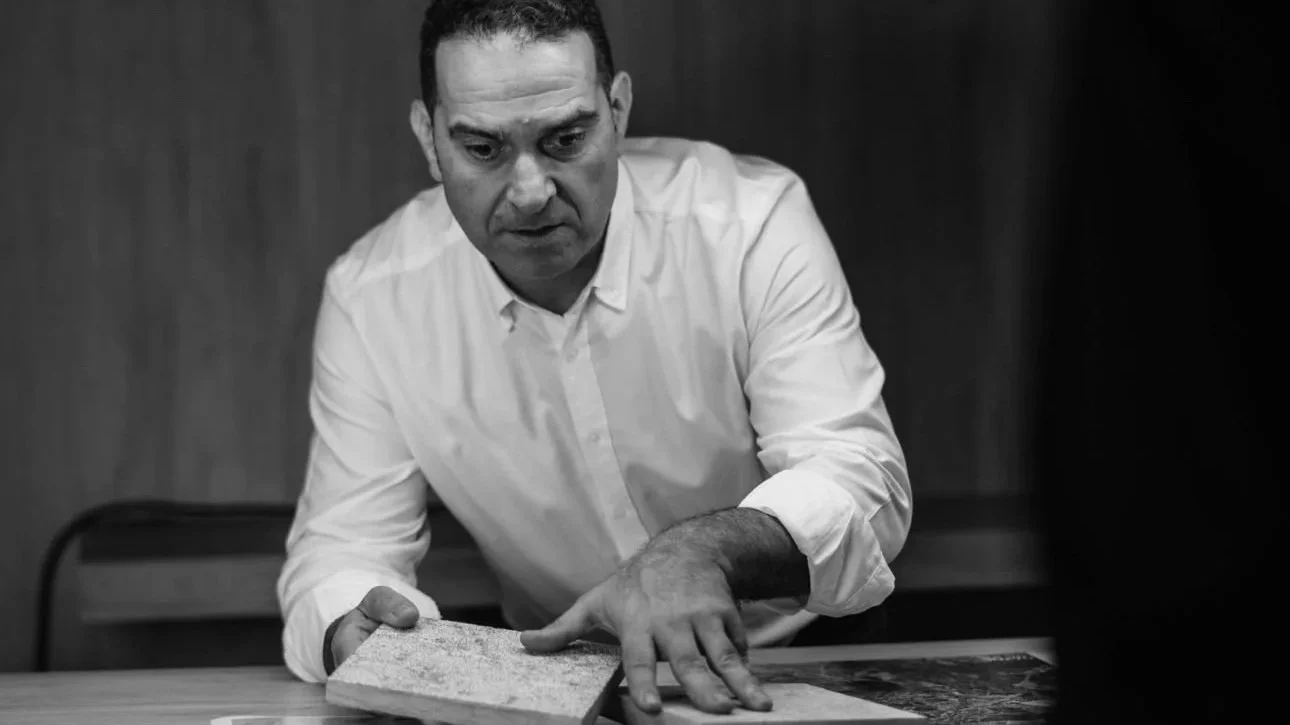
Jorge Ania, Stucio DC
Surface designer Jorge Ania, Studio DC, has spent his career teaching industrial printers to imitate stone, marble and wood. He spoke to FuturePrint about the move to digital that remade the ceramic tile industry, why wood décor has been so much slower to follow, and the half of the story that no machine can tell on its own.
The first time Jorge Ania saw a digitally printed ceramic tile, he wanted nothing to do with it.
‘Honestly, my first reaction was negative. I didn't like it at all,’ he admits. The resolution was poor. The colours were weak. The palette was boxed in by the inorganic inks that ceramics demand. Screen printing and rotary gravure already did the job, and Ania, by his own account, was comfortable with them. ‘I remember thinking: why change something that already works?’
He now sees that instinct for what it was, the reflex everyone has when a new technology turns up looking rough around the edges. ‘We usually compare an early version of a new system with a mature one that has been improving for years,’ he says. What changed his mind was the speed at which digital closed the gap, not only on resolution and colour, but on something he cared about far more. ‘I gradually understood that digital printing was not just a replacement for traditional printing. It was a different way of creating products.’ And that distinction has shaped everything he has done since.
Ania didn't set out to work in industrial print. He began as a graphic designer in a marketing and communications firm, deep in Photoshop, colour separation and four-colour work. But he happened to live in one of the world's great ceramic tile regions, and eventually joined a company trying to bring four-colour printing to ceramics on rotary gravure machines.
This is when his passion for design really started. Tiles, after all, exist mostly to imitate something else, to reproduce stone, marble and wood in a way that is more consistent, more durable and easier to lay than the real thing. Ania felt he wasn't simply decorating a product, but studying a material closely enough to recreate it. ‘When I look at a natural stone, I don't see only a colour or a pattern,’ he says. ‘I see depth, movement, irregularity, and the way different elements interact.’ Reproducing that convincingly is harder than it sounds. Too regular and the surface looks fake; too random and it won't hold together as a commercial collection. ‘Finding that balance is one of the things I enjoy most.’ It is, he says, a job he feels lucky to have. ‘I'm truly passionate about it.’
To understand why digital mattered, you have to understand what it replaced. Before it, ceramic decoration meant screen printing or gravure, which are very capable methods, but rigid ones. The engraved cylinders were expensive to prepare, which meant the print run needed to be long enough to pay for itself. Switching design meant stopping the line, changing rollers and readjusting the inks. Manufacturers carried stock of specific inks for every pattern, which made short runs and experiments difficult, and they could be very expensive.
There is also the issue of repetition. Because the design lived on a physical cylinder, only so many variations existed before the eye began to notice the pattern repeating itself. ‘That is not how natural materials behave in the real world,’ Ania points out. ‘A stone or a marble has different veins, movements and details. The elements are all different, but they still work together.’ Traditional printing could copy a design accurately, but what it struggled to do was to reproduce nature's variation, which is the very thing that makes nature look like nature.
Digital was able to solve two issues at once. On the production side, it allowed short runs, several designs in a single shift, even bespoke work for a single customer, without the constraints we mention above of the cylinders. On the aesthetic side, it brought higher resolution, a broader gamut and the ability to print onto texture. The main thing however he feels that it enabled designers to break free of having to include the issue of making it fit the technological process. ‘We can focus on the beautiful idea,’ he says, ‘instead of constantly having to adapt our designs to the limitations of the printing.’
One issue Jorge mentioned is the issue of speed. Digital is being compared to very fast analogue lines in square metres per minute. Ania feels this is not a fair comparison. ‘Speed is a problem technology can keep solving,’ he says. By adding printheads, adding print bars, throughput will go up. What is more important, in his view is colour control. This is what decides whether tomorrow's batch matches today's. Ink, printheads, substrate, calibration, ambient conditions need to have proper measurement and control. ‘For a customer, consistency is essential. If one batch of a marble looks different from the last, it creates problems with the customer and it damages trust.’
He also wants pointed out that the usual speed comparison between digital and traditional print only counts the time a machine is actually running. It doesn’t take the time into account when somebody has to swap rollers for a design change. ‘That downtime has a direct cost, and it should be part of the calculation.’ When looking at real productivity, running time and changeover time, digital's flexibility starts to feel far stronger.
It is a well-known fact that digital swept through ceramic factories quickly. Why did wood décor (the printed surfaces on furniture, panels and flooring), move at a far slower pace? Jorge gave us his informed opinion rather than stating this as a fact: In ceramics, factories printed in-house. Each one could see the benefit of digital on its own line immediately: shorter runs, faster changes, less stock, more freedom. In wood décor, decoration has traditionally been centralised, a small number of large companies producing printed material for many manufacturers. When the investment and the expertise sit in a few highly optimised plants, the decision to go digital becomes a far bigger decision due to enormous volumes, the return on major existing equipment, colour consistency across a whole supply chain. ‘The advantages may be distributed differently across the value chain,’ he says, ‘and that can make the transition slower.’ He believes that the technology was never really the obstacle, but possibly the structure of the industry.
However, he feels that is now changing. Panel makers, including the companies working in aluminium, SPC and PVC, are beginning to invest and the products are changing too. Manufacturers are moving beyond straightforward wood effects into marble, stone, concrete and more, with digitally applied reliefs coordinated to the printed design so image and texture complement each other. ‘The most important change,’ he says, ‘is not only how the product is printed, but what the product can become.’
He doesn’t think that the traditional paper-based businesses, will vanish, but they will have to adapt, and the ones that pair their industrial know-how with digital's flexibility will be strongest. ‘Digital is both a challenge and an opportunity.’ And he feels that technology is only half the story. The other half Ania believes is the freedom ‘to replicate what you can imagine’. For most of his career the situation was the other way round: the tools set the limits and the designer adapted. That is starting to invert, with the technology increasingly being able to work hand-in-hand with the idea. And this raises an obvious question when any competitor can buy the same equipment: where does that leave the competitive advantage?
Not the machine, in his view. ‘Even with exactly the same machine, two companies' products can be completely different.’ Start from the same, but the choices you make in colour, scale, movement, repetition, texture, can lead you somewhere totally different. Here he used an example of two artists using one model, identical brushes but arriving at two different paintings, because their perception and technique are totally different. ‘The machine is only a tool. What matters is how intelligently and creatively a company uses it.’
What is the sweet spot when he designs a stone, a marble, a length of wood? Realism, variation and harmony, but in balance. ‘Nature's beauty comes from its simplicity and its apparent perfection, and that's exactly what makes it so hard to reproduce.’ A good surface can't look artificial or too regular, and it still needs enough structure to function as a product.
And functioning as a product is what is pushing him beyond decoration and into performance. He is developing a countertop designed to be genuinely used, to be cut on, cooked on, lived with, but without compromising on its looks. ‘Every element in the home has a purpose,’ he says. ‘The design is beautiful, but the usefulness is what gives the product its real value.’
So, where does that leave the question of digital wood décor printing? Ania did not hesitate when telling us where he thinks wood panels are heading. ‘It's already happening. For me, it's mainly a question of time.’ The technology is maturing, the investment is starting, digitally decorated products are already on the market. The transition is slower than ceramics because the production models and supply chains are different, but the direction, he says, is not in doubt.
The opportunity, though, will be wasted if digital is used only to reprint the wood designs the industry already has. Its real value lies in new collections, more variety, customisation, so more in the art of creating rather than copying. ‘The industry is not deciding whether digital printing will arrive,’ he says. ‘It's deciding how to adapt to it.’
Jorge’s closing comment on his career spent between the natural and the manufactured: ‘Nature is the inspiration. Design is the interpretation. And technology is the tool that makes the idea possible.’
Jorge Ania is Sales Director of Studio DC
To listen to a recently recorded podcast please click here