
Communicating Gallus’s Reinvention Story: Jana Bachstein on Heritage, Change and Connection
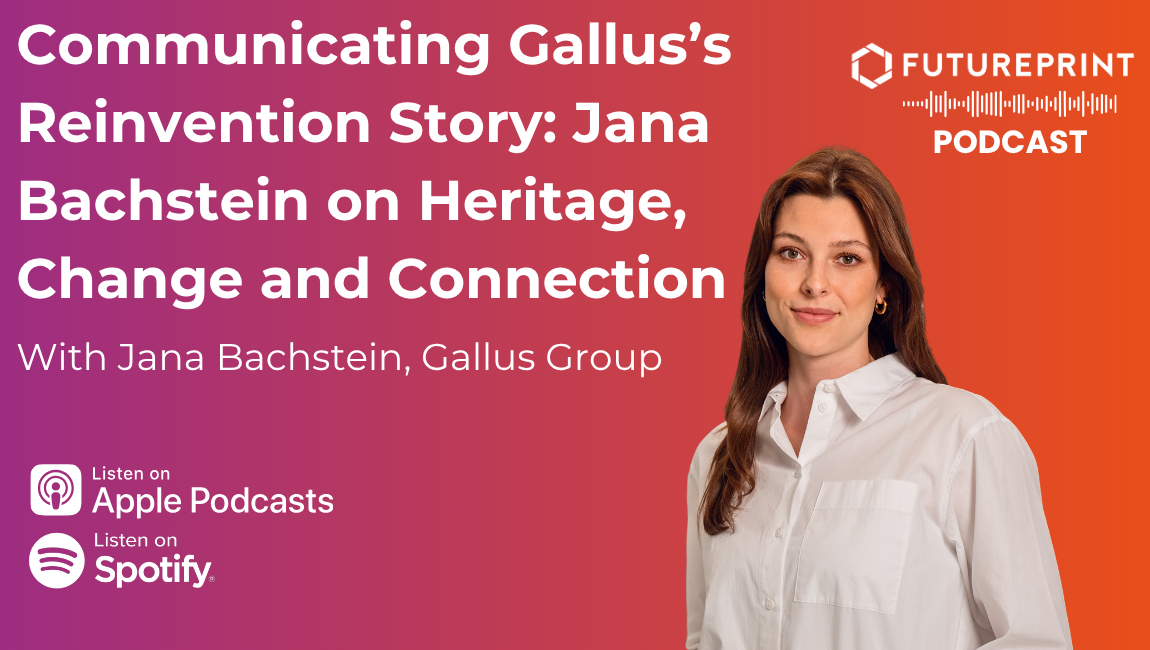
This article is based on a recent podcast with Jana Bachstein, Head of Marketing at Gallus Group and focuses on how a century-old press manufacturer is combining heritage, modular technology and human relationships to rebuild confidence in a changing labels market. Listen to the podcast here.
Industrial transformations are often described through machines. New platforms arrive, specifications improve and another generation of hardware is declared revolutionary. Yet the more revealing evidence of change is frequently less tangible: a company begins to speak with greater clarity, its employees appear more united and customers start to see not merely a supplier, but a business that understands where the market is heading. And what the market needs.
That is the story emerging from Gallus. The Swiss label-press manufacturer, part of HEIDELBERG, has spent recent years reshaping its technology, proposition and culture. Jana Bachstein, its Head of Marketing, joined three and a half years ago from B2C e-commerce—an outsider arriving as a 100-year-old company defined its next chapter.
Her first surprise was how much technology lay behind an object as apparently ordinary as a label. Like many consumers, Bachstein had barely noticed labels before entering the sector. She soon found herself studying bottles in supermarkets. What had previously always been a mundane everyday task became a window into advanced manufacturing: printing systems, software, automation, materials and sustainability, all connected through a value chain dependent on close collaboration.
This outsider’s perspective matters. Print’s products are ubiquitous, yet the ingenuity behind them is largely invisible. The industry compounds this by using technical language intelligible mainly to insiders. Bachstein had to learn that language, but also Gallus’s less codified elements: its relationships, expertise and culture.
Arguably, heritage can be either an asset or an alibi; established companies might sometimes invoke their history to resist uncomfortable change. For Bachstein, however, Gallus’s century of experience instead emerged as a foundation for change: proof that the company had continually evolved alongside its customers and markets. The task was therefore not to discard the past, but to honour it, distinguishing enduring strengths from habits that no longer served the market.
That required listening before broadcasting. Bachstein spent time with product management, R&D, sales, application specialists and HEIDELBERG. If the external transformation story bore little resemblance to employees’ experience, customers would detect the gap. Credible marketing and storytelling begins when ambition matches internal reality.
This principle is visible in Gallus’s attempt to broaden the meaning of innovation. At one end sits Gallus Classics, its refurbishment business, which extends the productive life and value of installed presses. At the other is System to Compose, a modular production concept intended to give converters greater freedom to configure and adapt their operations. One preserves earlier investments; the other prepares customers for new requirements. Both respond to the same commercial truth: converters need returns, resilience and manageable routes through change. Not novelty for its own sake.
System to Compose reflects a structural shift in the label market. Converters face labour shortages, pressure to automate, shorter and more varied work, and uncertainty over what tomorrow’s production mix will demand. A fixed answer to a moving problem soon becomes obsolete. Gallus therefore presents the press as one element within a broader ecosystem encompassing consumables, software, workflow, training and support.
The line “Compose your print masterpiece” avoids leading with engineering detail. Technical performance is essential, but customers do not ultimately buy specifications. They buy the ability to produce profitably, enter applications and respond to demand. The phrase translates modularity into business freedom, provided installations deliver the promise.
Gallus’s Experience Center in St Gallen gives that proposition physical form. Many manufacturers have demonstration rooms; fewer create places designed around exchange rather than display. The centre includes Gallus’s historical “time tunnel”, working technology, and around 20 partners. Its architecture makes an argument: no manufacturer, however accomplished, can solve every production challenge alone.
Bachstein recalls asking a customer what had impressed him most after a day there. It was not a single press feature, but the conversations, with Gallus staff and partner companies, and the ideas they prompted. This is a useful corrective to an industry inclined to place machinery at the centre of every story. Technology may bring visitors through the door, but dialogue helps them decide what the technology is for.
It also explains why physical engagement still matters. Online channels generate awareness, but an industrial press is a consequential investment. Buyers want to see it running, handle the output, interrogate the workflow and discuss production difficulties. Trust develops differently when engineers, operators and decision-makers share a room. Digital communication assists; it does not replace.
Gallus’s Labelexpo 2025 presence brought these elements together, projecting energy, partnership and confidence around System to Compose. But exhibitions are theatrical moments, and applause is not adoption. Credibility is established afterwards through demonstrations, training, support, customer stories and installations. The Gallus Print Academy and Experience Center help turn an ambitious concept into production results.
Beneath the technology story lies a human one. Customers do not form relationships with presses, Bachstein observes; they form them with people. In a business where relationships can span decades, expertise and personal continuity are strategic assets. Making engineers, application specialists and partners visible is not sentimental marketing. It shows customers who will help when production problems become real.
The same lesson applies to recruitment. To younger professionals, print may appear traditional or remote from the digital economy. Bachstein’s experience suggests the opposite. The sector brings together software, automation, sustainability, manufacturing, creativity and communication, while offering ample scope to make a visible contribution. Her advice is to resist judging it from the outside.
For Gallus, this new generation can also provide the productive tension that heritage companies require. Newcomers should first understand why a business has endured, then feel confident enough to challenge it. Respecting the past does not mean preserving every convention.
Bachstein hopes her contribution will be to have made Gallus more tangible and accessible without severing it from its origins. The broader ambition is more significant: to help print explain itself better, attract fresh talent and become confident enough not merely to prepare for change, but to shape it. Gallus’s transformation will ultimately be judged by customers and commercial results. Yet its direction offers a persuasive lesson. A century of history becomes most valuable when treated not as a destination, but as material from which to compose the future.