
HP’s work with Scuderia Ferrari HP brought together two printing technologies to meet very different demands, with lessons that could extend into labels and flexible packaging.
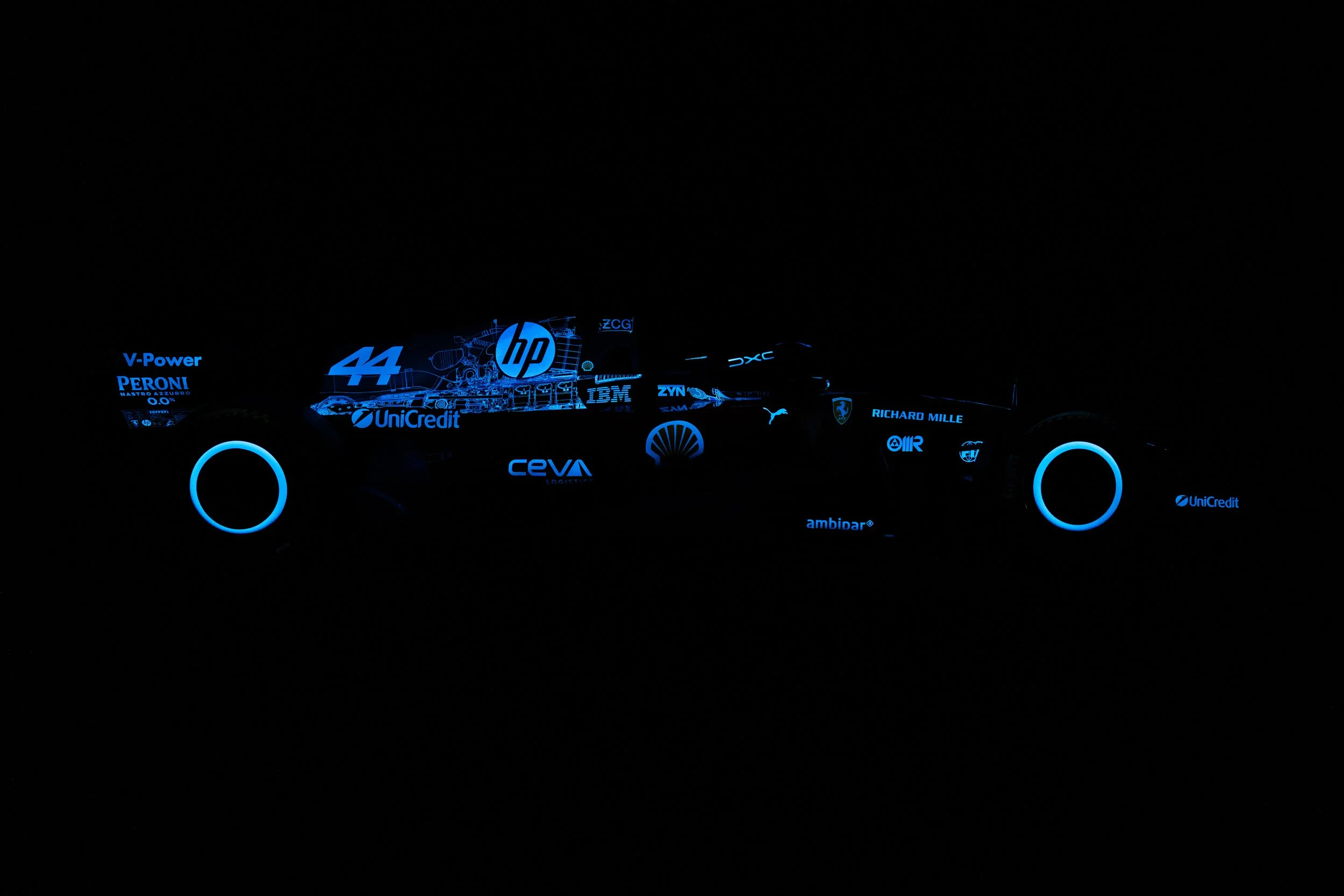
A design that appears as a black-and-white drawing in ordinary light, then fluoresces blue under ultraviolet light, sets an unusual brief for a printing team. Apply it to the contours of a Formula 1 show car and the challenge becomes more demanding. The printed material must take on a complex shape while retaining both the image and the effect.
That was one of the tasks facing HP in the special livery project for Scuderia Ferrari HP at the United States Grand Prix in Austin. The work combined two distinct applications within a single creative vision. HP Indigo produced UV-responsive graphics for a dedicated show car, while HP Latex was used for the race cars competing in Austin.
Ferrari conceived and designed the livery to reveal the drawings and engineering normally hidden by the bodywork, recognising the people behind the car’s development. That idea explains both the blueprint graphics and the display car’s hidden UV-responsive imagery.
The show car’s transformation under UV light began with Invisible Blue ink. HP drew on its existing expertise in printing processes, chemistry and inks to enable its use on the HP Indigo 200K specifically for this project.
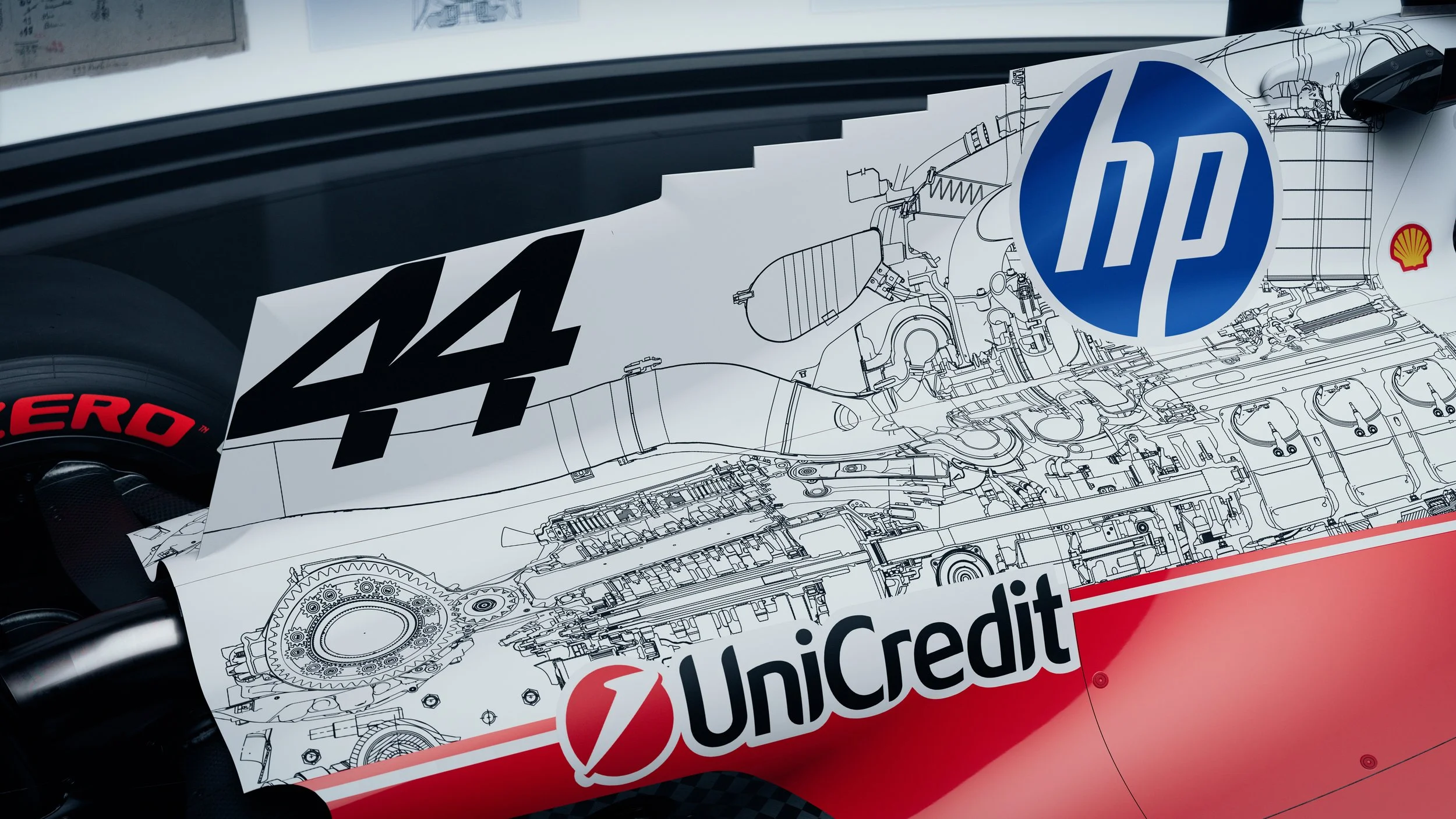
A design that appears as a black-and-white drawing in ordinary light, then fluoresces blue under ultraviolet light, sets an unusual brief for a print team.
Invisible inks already form part of HP Indigo Secure, the company’s security printing portfolio. In that setting, inks revealed by UV light are used for brand protection, authentication and track-and-trace applications.
The Ferrari brief required the ink to be combined with an unconventional vehicle-wrapping material. HP’s engineers evaluated print modes, primer chemistries and wrapping substrates to address adhesion, durability and flexibility.
Initial testing established that the selected material, ink and printing process could work together. The next challenge was to make the printed substrate conform to the car’s bodywork without the ink cracking or delaminating.
HP Z Workstations supported the digital design and engineering workflows used to map Ferrari’s artwork onto the car’s bodywork. The teams refined software, templates and print files, using tests on the vehicle to assess how the printed material behaved once applied.
Those tests informed adjustments to the position, overlay and coverage of the black and UV inks. Artwork and print parameters were refined together to achieve the intended appearance under both lighting conditions.
The race cars presented a separate set of requirements. Here, HP used its established vehicle-wrapping expertise and HP Latex technology to reproduce Ferrari’s detailed, blueprint-inspired graphics consistently across the bodywork. The materials and processes were designed to meet the durability and thermal performance demands of a Formula 1 race weekend, extending the companies’ ongoing collaboration on digitally printed race liveries.
HP says collaboration across its Graphics teams helped it explore development processes on a shorter timescale than would normally have been possible.
Haim Levit, Senior Vice President and Division President, HP Graphics Solutions Business, said:
“The most valuable innovation doesn’t end with a single application. The partnership with Scuderia Ferrari HP gives us an exacting creative challenge that brings together expertise from across HP Graphics and pushes us to think differently about what our technology can do. The knowledge we gain – from materials and inks to new production possibilities – can then be taken back to our customers, helping them differentiate their print, expand into new applications and create greater value.”
“The most valuable innovation doesn’t end with a single application. The partnership with Scuderia Ferrari HP gives us an exacting creative challenge that brings together expertise from across HP Graphics and pushes us to think differently about what our technology can do. The knowledge we gain – from materials and inks to new production possibilities – can then be taken back to our customers, helping them differentiate their print, expand into new applications and create greater value.”
For HP Indigo customers, the potential extends into labels and flexible packaging. HP says the testing expanded its understanding of Invisible Blue on the Indigo 200K and how primers, inks and substrates work together. Further development could allow printers to combine distinctive visual effects with brand protection on the same printed product.
Source: HP Graphics Solutions, The HP technology behind Scuderia Ferrari HP’s Austin livery, technical overview, pages 1–2.
Additional source: FuturePrint, HP Brings Ferrari’s Creative Vision to Life for the Special Austin GP Livery.