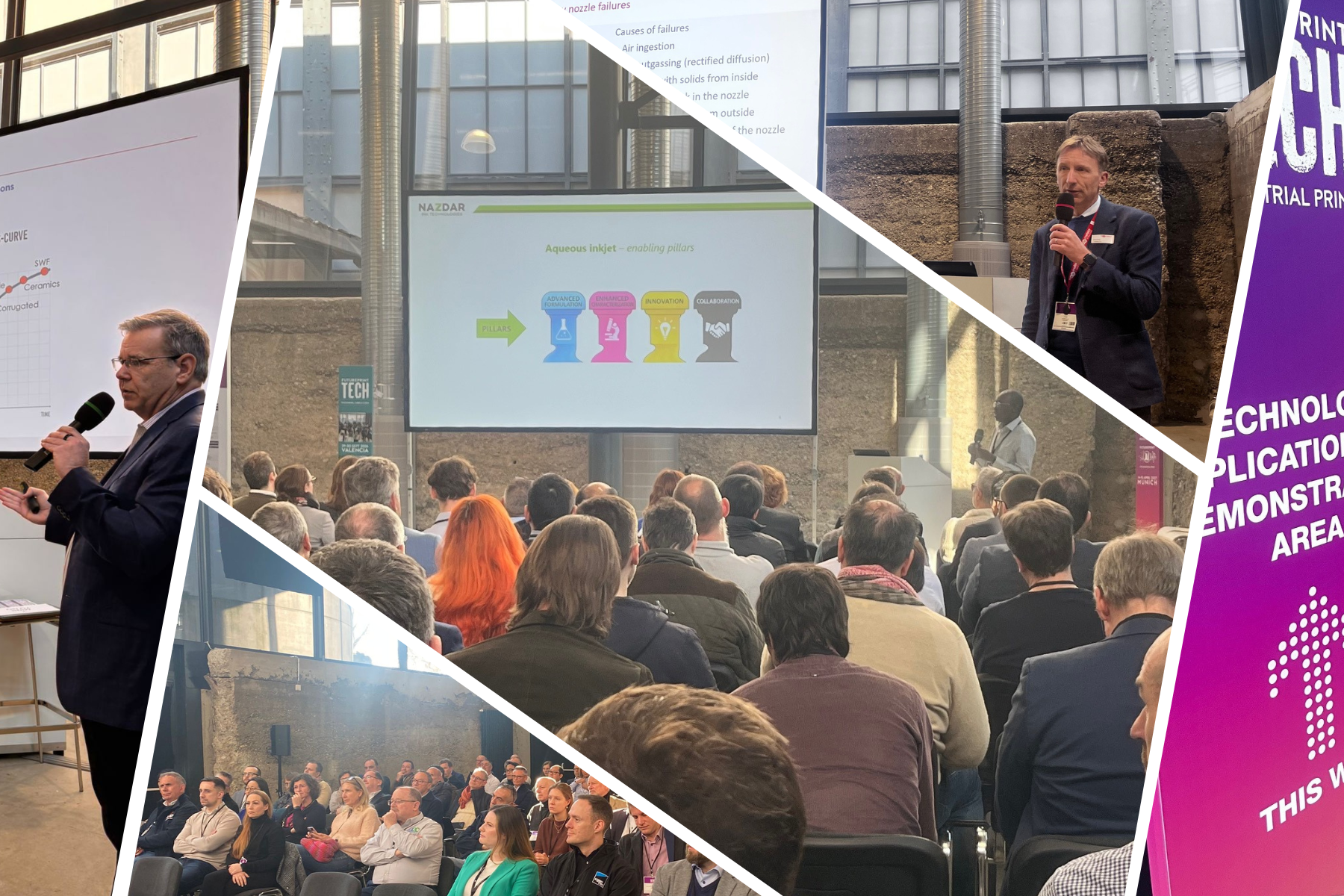
From proving inkjet to deploying it
FuturePrint Industrial Print in Munich was not a conference about convincing people that industrial inkjet works. That question was not under debate. What emerged instead, over two days of discussion, was a more consequential issue: how inkjet should be deployed when markets are volatile, development cycles are compressed, and production reality is unforgiving.
The tone in Munich was notably pragmatic. Across presentations, a shared frustration surfaced with perfectionism, over-engineering, and systems that look impressive on paper but struggle to earn their place on the factory floor. The emphasis shifted away from peak performance and towards usefulness. Not as compromise, but as strategy.
That argument was articulated most clearly by Global Inkjet Systems. Rather than celebrating technical ambition for its own sake, the focus was on positioning and timing. Systems designed to be good enough for mainstream applications, delivered quickly and economically, often outperform technically superior alternatives that arrive late, cost too much, or never quite stabilise in production. In an uncertain macro environment, usefulness becomes a competitive advantage.
The distinction matters because it reframes how success is measured. Speed to market, controllability, and repeatability now outweigh theoretical capability. Small steps that ship and learn can be more valuable than large leaps that stall. Inkjet, in this view, is not failing when it falls short of perfection. It fails when it is slow, fragile, or too expensive to deploy at scale.
That same thinking surfaced again from a different angle in the presentation by Inkatronic. Here, inkjet was framed not as a printing technology but as a digitally controlled material deposition tool for manufacturing. The emphasis was on chemistry-first development, validation under production conditions, and avoiding reinvention when scaling from R&D to factory. The most telling case study was not about speed or resolution, but about labour reduction, variant explosion, and system stability. Inkjet succeeded because it removed friction from production, not because it replaced an inferior process.
This shift in mindset is significant. Inkjet is no longer being adopted as a rescue technology. It is being chosen deliberately by manufacturers looking to unlock flexibility, shorten development cycles, and integrate decoration or functionality directly into production workflows. The technology has matured. The challenge now lies in execution.
Consumables provided another anchor point. Agfa made the case that many inkjet failures are not hardware failures at all, but system failures. Ink, drying, curing, migration, and compatibility with upstream and downstream processes ultimately decide whether an application survives contact with reality. When print becomes part of the product, chemistry can no longer be treated as a supporting detail. It is central to reliability, compliance, and cost.
This reinforced a broader theme running through the event. Industrial inkjet only works when it is designed as a system from the outset. Printheads, fluids, software, substrates, and production constraints are inseparable. Optimising one in isolation rarely leads to success.
Market discipline completed the picture. Gallus grounded the discussion in application economics, regulation, and run-length reality. Modular platforms, compliance-led development, and clear break-even logic all pointed in the same direction. Inkjet succeeds where it fits real jobs, real customers, and real production volumes. Innovations such as inline mattifying are valuable not because they are novel, but because they remove barriers to adoption in specific markets.
Taken together, the message from Munich was clear. Industrial inkjet is entering a phase defined less by invention and more by deployment. The technology stack is mature. The ecosystem is broad. What separates winners from laggards is the ability to ship useful systems, learn quickly, and adapt without waiting for ideal conditions.
To view all presentations from across the two-day conference, please click here.