
Kelenn Technology: Letting the Work Do the Talking
FuturePrint recently visited outskirts of Paris to see how Kelenn Technology puts its people and its products first, and what that means for the development of vital inkjet solutions.
There is no sign outside Kelenn Technology's building. Tucked away on the outskirts of Paris, it has no name over the door and nothing to mark it out from the road. The low profile has its advantages. It gives visiting customers a degree of privacy, and it fits how Kelenn sees itself: what matters is the work happening inside the building, rather than how it looks from the street.
People and product
Kelenn Tech puts its resources where the work happens. The premises are kept functional rather than showy, and the investment goes into the team. Throughout the building, there is a working atmosphere in which people enjoy what they do. "People and product" is how the company sums up its priorities, investing in people and product, not in place.
That same instinct shapes how the company sells. Everyone at Kelenn is effectively part of the sales team, and engineers take visitors round the machines themselves. Customers leave knowing more than they arrived with.
Solutions, not promises
Kelenn's mission statement is a single line: for the customer, remove the issues, provide the solution. The company talks about itself as a bridge between technology and solutions, and the team sometimes asks itself whether a new technology needs to be created.
That discipline runs the other way too. Kelenn will tell a potential customer no, if the fit isn't right or the request genuinely isn't possible, rather than pretend a solution exists when it doesn't. The question the team asks instead is a longer one: what will this customer need in future, and is there a shared vision of that future both sides can build toward together.
The tough R&D nobody wants to do
That same patience shows up in how Kelenn structures its own development work, which founder and CEO Didier Rousseau lays out as three distinct stages. The first is the print engine itself: fluid systems, electronics, the underlying work of making printing more precise and more efficient. "Some of the core activity behind the scene is really tough R&D, the one that nobody wants to do, because it takes years to finalise something," he says. "It took us maybe five years, ten years to get there."
The second stage is building what's described as a full process: not yet an industrial machine, but assembled from industrial-grade bricks of technology. The third stage is production and pre-production, where Kelenn prepares ahead of demand it can already see coming, so that when a customer does come calling, delivery can take anywhere from a few weeks to a few months rather than starting the clock from zero.
CAMCODE, Kelenn's camera-based motion control system, began as a tool the company built for its own use, because the alignment options available on the market at the time did not meet its needs. It took four years of development, and it has since become a commercial product in its own right, which Kelenn describes as industrial-grade and field-proven. We covered CAMCODE in more depth here.
The factory also has test rigs, including one used to develop new CMYK UV ink formulations for packaging and industrial applications. There, the team looks at the reliability of the printing and of the alignment, the performance of the ink and the precision. Just as with the building itself, the attention, like the investment, goes where the actual work happens.
One engine, many machines
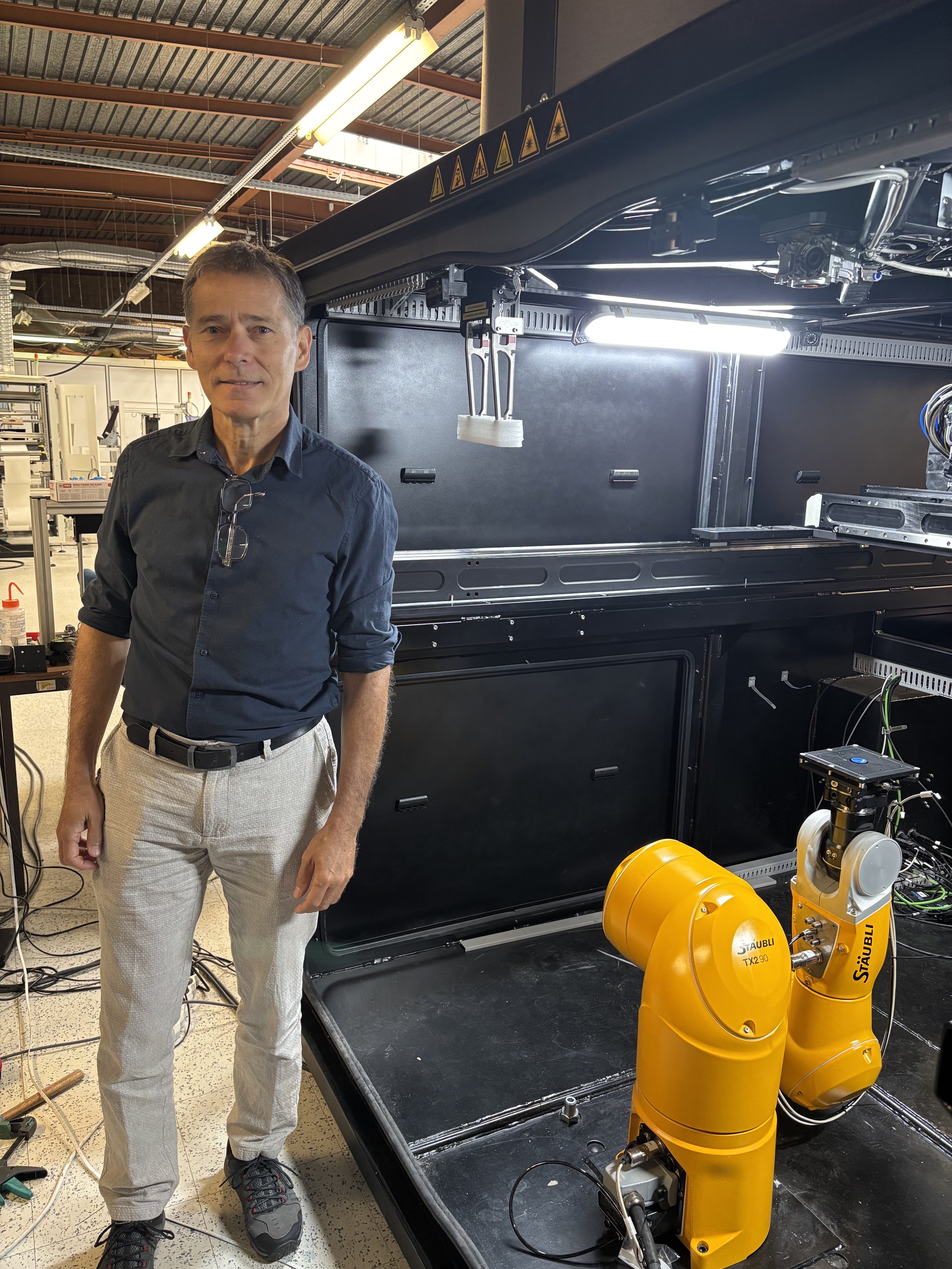
Didier Rousseau, CEO and founder, shows off a new piece of technoloy
Because that foundational work is done once and shared, the same underlying technology stretches across a wide range of applications. Kelenn prints 360 degrees around tubes in a single pass, develops packaging systems where adhesion, colour rendering, optical density and finish all matter, and builds small-batch structural electronics for prototyping. Direct mail is, by the team's own account, a big area for the company.
Much of Kelenn's manufacturing is for equipment manufacturers, who can choose small parts of its technology or the whole machine, then integrate and resell it. In a number of cases the company also delivers directly to end users, who are usually large ones. Either way, it's built from the same core engineering, adapted rather than reinvented for each new market. "The technology can be mutualised," Rousseau says, "and fit to different types of application and markets."
What comes next
Kelenn is developing something it calls Dot Lock, intended to replace UV-based ink in most applications. UV inks can bring issues depending on the ink and the application: chemical safety classification, smell, thickness, starch resistance or flexibility. Dot Lock, Kelenn says, is built to give printed material flexibility and stretch resistance.
